About this section
Essay Collections
Cancer Research
Clinical Practice
Papers on Journal Publication
Papers on Digital Health Systems
Military Medicine and Strategy
Multimedia

MEDICS RUGBY CHALLENGE
Peninsula Medical School v Royal Marines
Tuesday 5 November 2013
Plymouth Albion RFC
Gates open at 16:30
Under 16s match 17:30
THE BIG GAME 19:30
"September 2008 to April 2009 saw the largest deployment of Royal Navy Medics since the Falklands Conflict in 1982, a similar deployment occurred between April and October 2011. As a Royal Navy surgeon who was deployed on HERRICK 9 and 14 I witnessed first hand the consequences of war. I am involved in the treatment of our casualties and when I see them back in the UK I am amazed at their resilience, drive and motivation. To support their ‘return to normality’, please visit our website below and do your bit for our injured Servicemen and women."
Anthony Lambert
Plymouth Albion RFC, Madden Road, Plymouth, PL1 4NE
for up to date information please visit
www.medicsrugbychallenge.co.uk
A Surgical Team in the Storm: The Gulf War of 1990-1991
David A Rew
Consultant Surgeon, University Hospital of Southampton and the Defence Medical Services Reserve
Time and history march onwards. It is easy to forget the momentous political events of 1990 to 1991. In Northern and Central Europe, the post-Stalinist artifice of Soviet dictatorship collapsed with the Berlin Wall, the re-unification of Germany and the peaceful accession to independence of the Baltic States, Poland, Czechoslovakia, Romania and Bulgaria with the Gorbachev reforms. In Southern Europe and the Balkans, the Serbs, under the late and little lamented Slobodan Milosevic, were initiating the events that led to the fragmentation of the former republic of Yugoslavia in circumstances which became reminiscent of the worst horrors of World War Two.
In the Middle East, the Iran-Iraq war of in 1980 to 1988 had led to the deaths of up to a million combatants and civilians. Notional victory for Iraq had given an empowered, emboldened and generously equipped Iraqi Army the wherewithal to accommodate the further expansionary and neo-imperial ambitions of Saddam Hussein. On 1st August 1990, the Iraqi Armed Forces surged into Kuwait, capturing the country and its oil resources, and initiating an orgy of looting and abuse of Kuwaiti residents. This created an immediate and existential threat to the oil fields of Eastern Saudi Arabia over an axis stretching some 300 miles to the South, and hence to Western economic and political interests.
The personal notoriety of Hussein and his security forces, the takeover by force of an independent state, and the existential threat to Western economic interests helped to provide a powerful narrative for an immediate collective Western military response, led by the United States, which grew into the remarkable military operation now known as Operation Desert Storm.
Operation Desert Storm/Operation Granby
Operation Desert Storm, to which the UK contributed some 40,000 personnel under the somewhat less memorable title Operation Granby, encompassed three broad phases.
The first phase, from August to December 1990, saw the urgent progressive development of a defensive “line in the sand” and reinforcement of military forces in Saudi Arabia, which included the British 7th Armoured Brigade, the “Desert Rats” of World War Two fame. It was accompanied by the construction of a broad political coalition and international efforts to secure the peaceful withdrawal of Iraqi forces from Kuwait.
The second phase, through January and early February 1991, saw a transition to preparation for offensive ground operations to recapture Kuwait. There was a massive build up of coalition forces to some 500,000 personnel, including the US VIIth Armoured Corps and the UK 4th Armoured Brigade from Germany, and a six week strategic air campaign which began in earnest on 17th January 1990. Under cover of the air campaign, a huge deception plan was executed to place the Allied armies on position for a turning movement around and beyond Kuwait, across hundreds of miles of desert. This turning manoeuvre was subsequently known as General Norman Schwarzkopf’s Hail Mary Play, after an American Football strategy.
The third phase saw the execution of this plan with brutal speed and efficiency across the desert wastes. While the US Marines, Saudi Arabian, Egyptian and Syrian divisions conducted what were intended to be diversionary attacks against Iraqi fortifications on the southern border of Kuwait, the US-UK 7th Corps crossed the border minefields, surged up the Wadi at Batin and into the Iraqi divisions occupying western Kuwait. Further to our left, the US 18th Corps raced towards Southern Iraq and to the destruction of the Republican Guard divisions which formed the Iraqi strategic reserve. An operation which had been expected to take weeks was wound up within 100 hours.
The British military medical plan
For the British Army and for the UK 1st Armoured Division, this operation represented a return to a form of manoeuvre warfare and operational art in which it had learned many hard lessons in the North African desert in the Second World War. The Northern Arabian Peninsula covers an enormous land mass of flat, stony desert. Planning distances between the logistic port of Al Jubail on the Gulf Coast, the strategic airfields in Riyadh and the border with Kuwait were between 300 and 500 miles. The allied casualty estimates were very high (in the thousands) and there was a perceived threat of chemical warfare from the Iraqis. The medical and surgical support plan required a high degree of forward deployment of resources, to ensure credible timelines for casualty evacuation to suitable points of care, using helicopter (Huey, Puma, Chinook) and fixed wing (C-130 Hercules) air transfer of casualties to base hospitals in Saudi Arabia and the UK.
Initially, a Regular Army Field Hospital (No 33) was deployed to a base area in Al Jubail on the Arabian Gulf coast to support the defensive build-up of troops. As the scale and need for offensive operations became clear, so the medical plan expanded to include an Evacuation Hospital (No 205 Scottish) at the Airhead at King Khalid International Airport (KKIA) in Riyadh (where an unfinished airport terminal became available for conversion to that purpose) and two forward Field Hospitals (No 22 and No 32) in the area of Hafr al Batin on the Northern Saudi Arabian border, in support of the Armoured build up.
The mobile armoured warfare would be supported by two truck-mounted Forward Surgical/Advanced Resuscitation Teams, embedded with the Field Ambulance Units and dressing stations attached to the Armoured
Brigades. The front-line medical units would be linked to the field hospitals by helicopter evacuation and evacuation rearwards would then be by C130 Hercules transport aircraft.
It soon became clear to the planners that the medical plan could not be staffed without a substantial draw upon the territorial reserves, into both the forward surgical teams and the field and evacuation hospitals. At the time, Stuart Scott and I were working as registrars in Professor Irving Taylor’s University Surgical Unit at Southampton General Hospital. We were both active members of the TA with airborne forces experience. A few ex-officio phone calls up the Chain of Command in September 1990 secured us places within the Forward Surgical Teams attached to 7th and 4th Armoured Brigade. These teams were tasked with immediate Damage Control Resuscitation and stabilisation of combat casualties for further evacuation, rather than for heroic battlefield surgery.
Mobilisation and deployment into the Desert
The call up of reserves was a major national and media event in the winter of 1990, as it was the first time that it had been undertaken in many decades. In an era before mobile phones, some 700 medical reservists found themselves in a bitterly cold Saighton Camp near Chester in early January 1991 with (initially) a single telephone line out, for a week of preparation and vaccinations against all manner of biological warfare agents. We then transferred to RAF Brize Norton and onto a requisitioned Kuwait Airways Boeing 747 aircraft for a direct flight into Riyadh.
We arrived at King Khalid International Airport on the evenings of 15th and 16th January 1991, where the stores of the nascent 205 (Scottish) Evacuation Hospital (Volunteers) were being offloaded from a fleet of freight containers in the car park and into the commandeered shell of an airport terminal. The following day, the war began in earnest. It was heralded for us by the launch of a large fleet of USAF DC10 air refuelling tankers, and by the arrival overhead of a well targeted series of Iraqi SCUD missiles. This heralded the initiation of one of many disruptive chemical warfare alerts, driving everyone into respirators and “noddy suits”.
A few days later, the reservists in the field surgical teams were detached from 205 and were flown up by RAF Hercules into the airhead at Al Jubail, where we linked up with our field surgical team colleagues from 23 Parachute Field Ambulance. Our equipment comprised two Bedford trucks with trailers, tentage and basic surgical and anaesthetic equipment. My later discussions with the late Mr Bernard Williams, who had led a surgical team in the desert war of 1941-43, revealed how little had changed in the intervening years.
We were tasked to join the Armoured Field Ambulance and Dressing Station units already deploying into the desert. This necessitated a 300 mile drive north up the Tapline Road to the initial Assembly Area in the desert south of the Kuwaiti border, where massive logistic convoys were filling the road in both directions as they shuttled to and from the Front.
For the next six weeks, we were preoccupied with military preparations for the recapture of Kuwait. This involved a massive deception programme, during which we moved far into the desert to the west of Kuwait to rehearse the complex manoeuvres of breach (minefield) crossing, passage of lines and interoperation with the US Army, along with the other elements of mobile armoured warfare which are recorded in detail in many of the contemporary books on the War (see further reading section).
In marked contrast to the modern and intensive clinical training for deployments to Afghanistan, our clinical preparation at that time was very basic, primarily consisting of brief discussions of anastomotic stapling techniques and of the decontamination of chemical casualties. We rehearsed the rapid setting up of trackside treatment facilities and helicopter casualty transfer, but our capacity for effective work under heavy casualty flows would have been very limited.
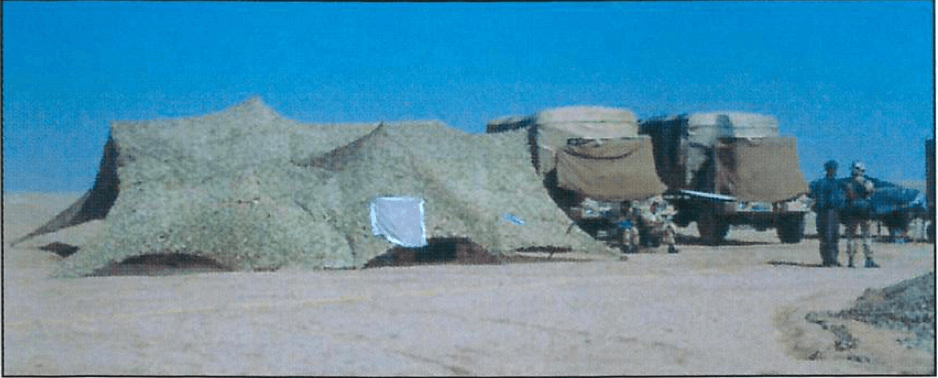
The SAFA Surgical Team during six weeks of field manoeuvres in Northern Arabia, prior to Operation Desert Storm, February 1991
Our specific mission was to move with 5AFA, the Close Support Medical Unit with the 4th Armoured Brigade, which was to alternate with the 7th Armoured Brigade in a "dual fist" punch across the Wadi al Batin on Kuwait’s western border, and on through the dense network of Iraqi defensive positions in depth across Kuwait. The medical plan included the establishment of a treatment facility at the initial border crossing into Iraq (which proved unnecessary) and flexible manoeuvre with the fighting echelons thereafter as combat operations developed. Memorably, our high mobility on the flat and featureless desert was assisted by then secret technology in the form of the earliest models of GPS receivers, which we had never previously seen. These were the size of shoeboxes, with a ravenous hunger for battery power. How technology moves on!
Into the Desert Storm
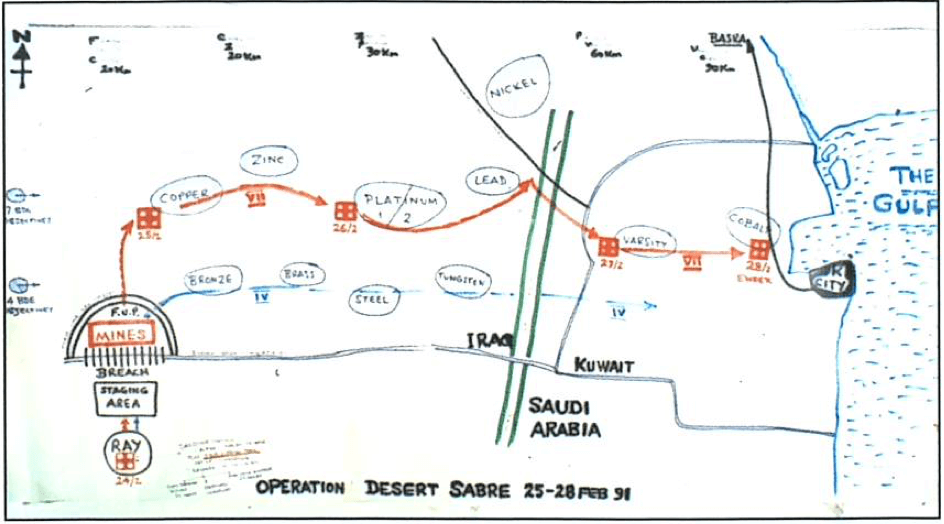
After a seemingly interminable wait, we were finally called forward with the assault formations on 24th February, and drove along the bulldozed routes through the border minefield and trench lines into Southern Iraq. The 1st UK Armoured Field Ambulance team, to which Stuart was now attached, headed north with 7th Armoured Brigade, while 4th Armoured Brigade and 5AFA headed east with 4th Armoured Brigade towards the Iraqi divisional and defensive concentrations, designated as area targets with the names of metals. Given the anticipated pace of operations, 7th and 4th Armoured Brigades were to strike alternatively and sequentially against these objectives. In practice, as the operation turned
into a route, both brigades raced headlong towards the end point on the Basra-Kuwait Highway and the blazing oilfields as the Iraqi Army disintegrated.
An informal sketch map of 1st UK Armoured Division movements and those of the forward surgical teams during Operation Desert Storm, between 24th and 28th February 1991. The direction of attack was from left to right after breakout through the minefields on the Iraqi border. The blue circles with metallic codenames indicate major Iraqi Army concentrations. The hand-drawn sketch, kindly provided by Lt Col Stuart Scott, shows the routes of the Field Surgical Teams accompanying VII and IV Brigades.
We ourselves took large numbers of bewildered and hungry prisoners who emerged from the trench systems and bunkers around us when we stopped. However, despite predictions and subsequent misinformed reports, the casualty workload was negligible. We undertook a single trackside operation on an Iraqi soldier with minor fragment injuries and helicopter evacuation of one other group of casualties.
The Iraqi Army imploded through fear, mass desertion, interdiction of supplies and the collapse of morale rather than through death and injury. This was just as well, as we were highly vulnerable to the anticipated Iraqi artillery counter-strikes, which thankfully were not forthcoming. Body armour was not issued, and our soft skinned trucks and canvas tents would have offered no protection under fire.
In truth, the campaign unfolded so rapidly that casualties were far fewer on both sides than had been predicted. Many of the Iraqis had already fled the battlefield, and those who remained surrendered en masse in the face of a prolonged air campaign and a torrential envelopment by rapidly advancing coalition forces, and the fearsomely destructive power of our new multi-launch rocket systems, the “grid square removers”. Our surgical contribution was limited to minor treatment of a small number of Iraqi casualties prior to helicopter evacuation.
As it was, the battlefield was almost empty of casualties, despite the lurid headlines and estimates. Of the intelligence estimate of 400,000 Iraqi combatants in the Kuwait theatre at the outset of operations, it is highly likely that up to 50% had deserted, been withdrawn or redeployed before the ground assault began. Of those Iraqis who were still in Kuwait, many were deeply dug in during the assault, using buried steel freight containers to good effect as underground bunkers. Many were profoundly short of food and water, such was the effect of the logistic disruption from air attacks, and very few had any stomach for resistance. 175,000 Iraqi soldiers were taken into temporary holding camps.
In clinical terms, our exercise in surgical battlefield tourism was thus ineffectual and largely untested. It was undoubtedly necessary for the planners to have surgical and anaesthetic boots on the ground with the combat troops, but in practice, the speed and fluidity of the action meant that we were rarely able to be in the right place at the right time. With our limited clinical capability, our relative inexperience of war trauma and trauma physiology, our lack of any ITU or HDU capacity, and where post-operative care would have been very restricted if the air evacuation plan had broken down, it is likely that we would soon have been overwhelmed by significant numbers of casualties.
Such few casualties found by UK forces were rapidly flown off by Puma helicopter to the field hospitals at Hafr al Batin. The practice of in-flight medical care in dedicated UK casualty evacuation helicopters, which has since been highly refined in the MERT concept in Afghanistan, had not been developed or explored in 1991.
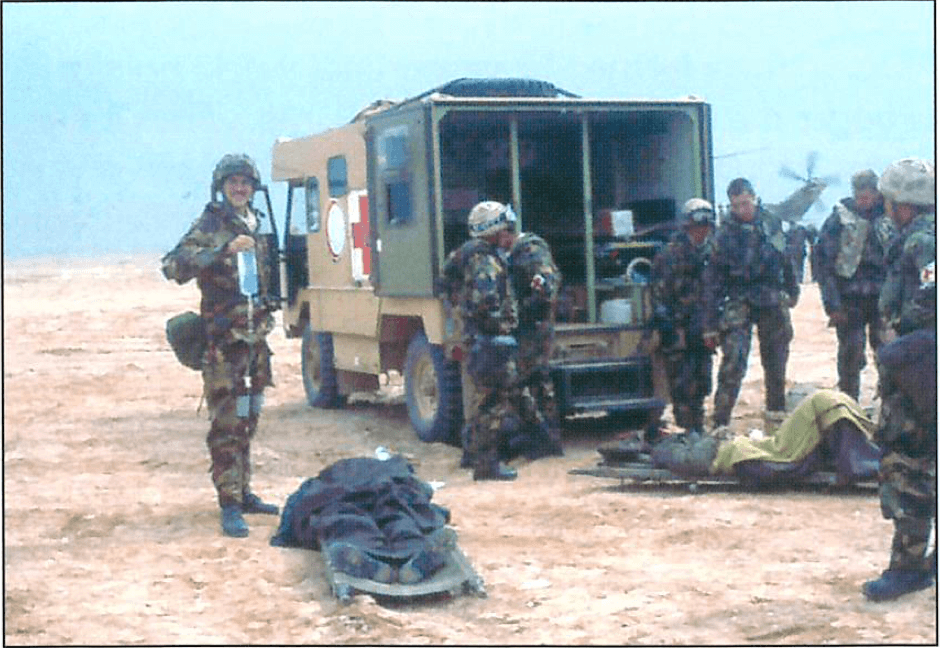
Impromptu casualty care at an exchange point pending air evacuation, South West Iraq, 26th February 1991
A makeshift trackside operating theatre at dusk, SAFA surgical team, Wadi Al Batin, 27th February 1991
Reflections on the Operation
I have many extraordinary recollections of those times. In one particularly memorable moment, we found ourselves in the morning mist to the fore of an armoured assault on Iraqi positions as it was launched, when we had inadvertently got ahead of our own tanks and the guns. We were witness to a massed artillery and rocket barrage, which lit horizon to horizon with primary and secondary explosions, to the debris of war all around us, and to the surreal experience of lorry loads of Iraqi conscript POWs cheering the “British Paras” forwards as the Hussein regime headed towards collapse.
Military Surgery
Evacuation of an Iraqi casualty by Puma Helicopter in South Western Iraq, on 26th February 1991
Thus, the UK medical plan was never tested against the anticipated casualty templates, although it worked extremely well in the circumstances of the few hundred trauma casualties who entered the system. Most of these were Iraqi conscripts who were returned to Iraq through a Swedish Field Hospital. Within the plan, the mobilisation of NHS medical reservists proved to be both essential and successful. It demonstrated, once again, the capability and flexibility of a trained military medical reserve, which had lain dormant since World War Two. It led to the Reserve Forces Act of 1996, which heralded far greater use of the reserves in subsequent operations in the Balkans, in the Second Gulf War of 2003-09, and in Afghanistan from 2005 onwards.
One curious medical fall out was “Gulf War Syndrome”. This appears to have emerged in consequence of the rapid mobilisation, of the prevalent anxiety surrounding the vaccination programme against biological warfare agents, of the general stresses of fears of deployment onto a potential chemical battlefield and from awareness of the depleted uranium armour piercing shells. GWS has since been extensively investigated and has not been substantiated. One benefit of the GWS saga has, nevertheless, been the much improved academic programme of military mental health surveillance. This has evolved as a partnership between the MoD and the King’s Centre for Military Health Research and continues as a survey of the Health and Well Being of UK Armed Forces Personnel under the excellent and courageous direction of Professor Sir Simon Wessely.
An operational footnote
There is one operational historical footnote which deserves to be aired and reflected upon before it is airbrushed from history through political expediency. The “Eve of Battle” Order of General Norman Shwartzkopf, the Field Commander in Chief, which translated into the Battle Order of the First UK Armoured Division under General Rupert Smith, was clear and explicit in its intent. It made clear the intent to ensure the total destruction of the five Iraqi Republican Guard Divisions which were the backbone of the Army and of Saddam Hussein's hold on power. General Schwartzkopf’s intent was never realised.
On the evening of 28th February 1990, with our combat power entirely intact, we were directed to Basra to help secure the elimination as a fighting force of the one surviving Republican Guard Division, the Hammurabi Division, which would have led to the removal of Saddam Hussein from power. The order was countermanded when the imagery of devastation of the routed Iraqi Army on the Basra highway on the Mitla Ridge in its retreat from Kuwait persuaded President George Bush to call an end to operations before the battle order was fulfilled.
General Schwartzkorpf was subsequently hoodwinked in the surrender negotiations at Safwan into allowing the Hammurabi Division safe passage northwards. It was neither disarmed nor dismantled, but headed for Basra and its rebellious population. Basra was left unprotected in a subsequent uprising against the Hussein regime and between 30,000 and 70,000 Basra inhabitants were slaughtered by Iraqi forces, led by the tanks of the Hammurabi, in the most depraved and barbaric manner, while the coalition armies were obliged to stand by. Further north, huge numbers of Kurdish people were also slaughtered and driven into the mountains as Saddam Hussein vented his wrath upon them. General Schwartzkopf was obliged to bite his tongue while a human tragedy unfolded at far greater cost of life than was ever the ground reality of Operation Desert Storm.
The Iraqi people were left to the will of Saddam Hussein for a further 12 years, until world politics brought the military focus back to Iraq. Thus it was that we found ourselves on the Basra Kuwait highway once again in March 2003, a few miles from the precise starting point where we concluded operations in 1991. But that is another story.
The Southampton Surgical Unit homeward bound from Riyadh in early March 1991 on the remnant of a SCUD Missile
Further reading
Rev D
The mother of all excuses to take study leave
Association of Surgeons in Training Yearbook 1992
Rev D, Scott S D
Gulf War casualties revisited
BMJ 1993 Apr 17;306(6884):1071
Cordingley P
In the Eye of the Storm: Commanding the Desert Rats in the Gulf War
Hodder and Stroughton Canada 1996 ISBN 0340684250, 9780340684256
de la Billiere, Sir P
Storm Command. A personal account of the Gulf War
0006387497 (ISBN13: 9780006387497) Harper 1992
Clancy T, Franks F
Into the Storm
Putnam Books 1997
It Doesn’t Take a Hero: The Autobiography of General H. Norman Schwarzkopf
Bantam Books 1993-09-01. ISBN 978-0-553-56338-2
Benefits of Membership
As well as representing Fellows in the professional and political arena, the Association recognises the need to provide practical membership benefits. ASGBI is proud that, over the past two years, a range of world-class publications and services have evolved, and that there are exciting plans for this growth to continue into the future. Find a list of our member benefits below.
Journal of the Association of Surgeons of Great Britain and Ireland (JASGBI)
Back issues of the Journal can be found at http://www.asgbi.org.uk/en/publications/Journals.cfm
Issues in Professional Practice
This series of AS publications is now quite extensive; publications can be found at http://www.asgbi.org.uk/en/publications/issues_in_professional_practice.cfm
Postgraduate Qualifications
Discounts of up to 40% are offered on post-graduate CPD degrees (MSc, MBA, MEd etc.) through Dundee, Nottingham and Leeds Metropolitan Universities.
ASGBI “App”
ASGBI was the first surgical association to have its own dedicated iPhone “App”.
Surgical Indemnity Scheme
ASGBI now have our own indemnity scheme, the Surgical Indemnity Scheme (SIS). This is a wholly-owned subsidiary company of the Association and provides bespoke quotations for all surgeons.
The Surgical Foundation
Over the past few years, our charitable arm, The Surgical Foundation, has incrementally increased the number of International Bursaries offered, by competitive application, to Surgical Trainees from the developing world to attend the ASGBI International Surgical Congress (2 in 2008; 6 in 2009; 16 in 2010).
International Surgical Congress
The Annual Congress remains the “highlight” of our year. Liverpool in 2012 and Glasgow in 2013 were both an outstanding success. The themes were 'Expertise & Excellence' and 'A Century of Surgery' respectively, and we had around 1,200 registered delegates for each event. There is no doubt that ASGBI’s philosophy of encouraging discussion of generic topics of interest to all surgeons has proven most successful. ASGBI members receive a 20% discount to the Congress.
Further information on member benefits and how to join can be found at: