
A Grave on the Khyber Pass:
The short life and premature death of Assistant Surgeon Donald EE White
David Rew QVRM TD MChir (Cambridge) FRCS (London)
Consultant General Surgeon, Southampton Hospitals
Honorary Consultant Surgeon to the Faculty of Medicine, University of Southampton
Late Colonel, UK Territorial, Regular and Army Reserve 1975–2018
UK Airborne Forces and Defence Medical Services Reserve
Published 30th September 2024: Copyright David Anthony Rew
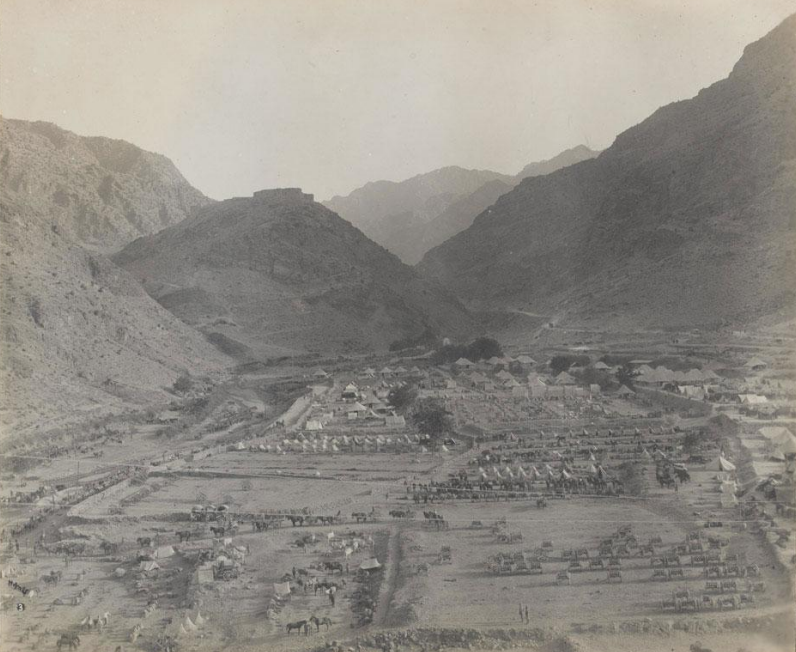
Frontiespiece: Ali Masjid Fort and British military camp, 1919.
Frontispiece: Ali Masjid Fort and British military camp, 1919.
Introduction
This is the story of a series of events and remarkable coincidences which briefly touched on my own life and which coalesced over several decades. It follows from the murder of a young Medical Officer in the course of his duties in 1919 at the far end of the Khyber Pass in the brutal physical, political and social landscape on the North West Frontier of India, which is nowadays the Khyber Agency of Pakistan.
It is the story of Dr Donald E White, a father who never met his own daughter or grandchildren. It spans the globe and the generations as his family left India at the time of Partition for a new life as refugees of Receding Empire, eventually finding a new life in British Columbia in Canada. It takes us back to the India of the 18th Century during the Raj, then on to China; then back and fore across the Pacific and Atlantic to Canada and Britain by steamship; and into the Internet age.
The events follow from my unplanned visit to his grave in 1988, and the subsequent paper that I published in 2012 about my researches into his death. Remarkably, this paper led to a contact from his sole surviving grandson a decade later, which in turn led to the revelations of a rich family history.
Above all, the story illustrates once again how random events, and the actions and decisions of individuals, have profound consequences on lives across the generations and across the globe. Such is the fundamentally unpredictable nature of our singular existences.
Frontispiece Photo and Original Caption: Ali Masjid fort is visible on the hilltop in the middle distance, with a temporary British camp in the foreground. The fort was located at the centre of the Khyber Pass, protecting its narrowest point.
During the 3rd Afghan War (1919) Afridi tribesmen attacked British convoys in the pass as they advanced to relieve Landi Kotal. In response, units from the 2nd Division were stationed at Ali Masjid to guard the lines of communication in the Khyber.
From an album of 43 photographs, 1920 (c)-1925 compiled by Major G A Clarke, 12th Pioneers (The Kelat-i-Ghilzie Regiment).
National Army Museum, Out of Copyright NAM. 1963-09-633-5
https://collection.nam.ac.uk/detail.php?acc=1963-09-633-5
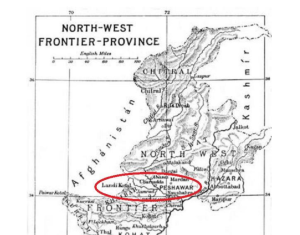
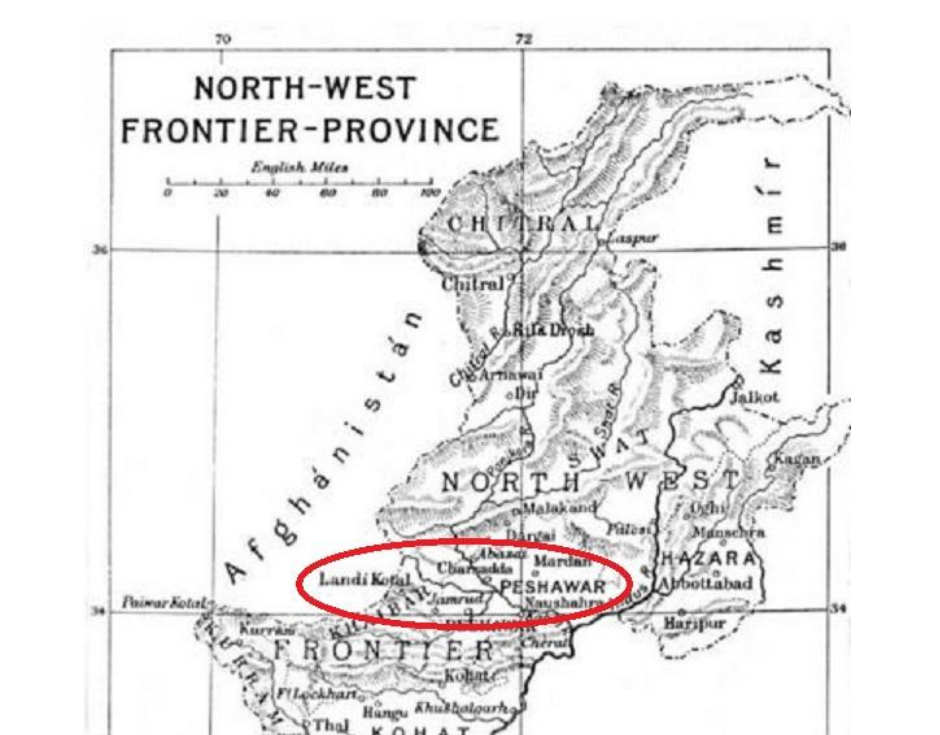
Figure 1: Map of North-West Frontier Province c1916 (from a book by Sir James McCrone
Douie). The route from Peshawar to Landi Kotal, with the CWG Cemetery, is highlighted.
Figure 1: Map of North-West Frontier Province c1916 (from a book by Sir James McCrone Douie). The route from Peshawar to Landi Kotal, with the CWG Cemetery, is highlighted.
My Introduction to the North West Frontier
I qualified in Medicine and Surgery in 1981 from the University of Cambridge and Kings College Hospital, and I embarked upon a career in General Surgery. In parallel with my early NHS career, I enjoyed a part time career with Airborne Units of the Territorial Army. At a Regimental Dinner in London in early 1988, I was introduced to the late Rupert Chetwynd, who was described in the header to his Obituary in The Times of Thursday 24th June 2021 as a “Bohemian SAS soldier, advertising executive and adventurer who led humanitarian missions into Soviet-occupied Afghanistan” (1).
By the summer of 1988, Soviet Russian military adventurism in Afghanistan was at an end, and a withdrawal was in progress. Over the past decade, several millions of Afghans had been displaced into the sanctuaries of the North West Frontier Province of Pakistan. The medical care there was ad hoc, and largely under control of the various religious and political Afghan factions.
Rupert had developed connections with a group of health professionals from the Royal Surrey County Hospital in Guildford, who were planning a medical outreach expedition to the Afghan refugee hospitals in Peshawar, under the auspices of The Afghan Aid Charity. He was looking for a surgeon with an adventurous pedigree, so his pitch was easily made.
With generous leave of absence from St Mary’s Hospital Portsmouth Surgical Unit, I found myself working in and around various charitable hospitals in Peshawar in October 1988. Rupert used his connections to organise adventurous trips around the North West Frontier. We went as far north as Malakand and Swat, and as far west as Landi Kotal at the distal end of the Khyber Pass. This is the bandit country of the Khyber Agency, beyond which the mountains of the Hindu Kush fall away to the Khandahar plain.
I was privileged to join one such foray up the Khyber Pass to the Afghan border. During this drive, we were taken by our local guides on a slight detour off the narrow highway to the Commonwealth War Graves Commission Cemetery of Ali Masjid, which is near the site of a small fort at the narrowest point in the Pass.
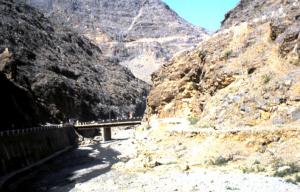
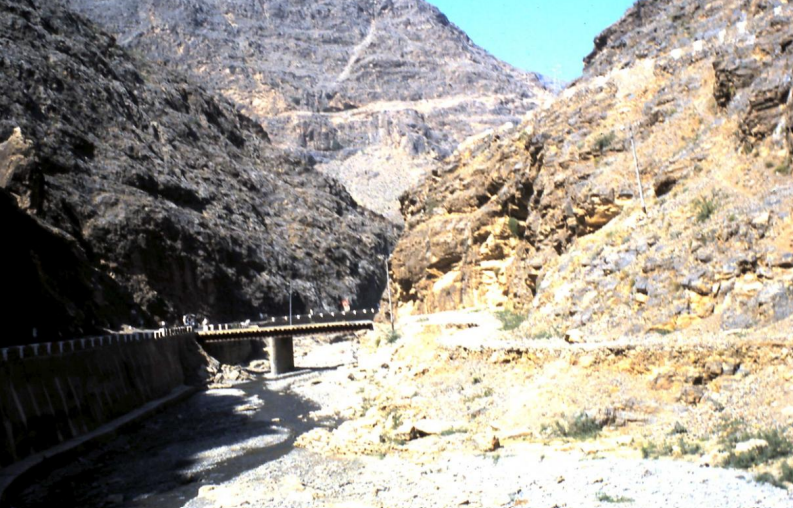
The Khyber Pass narrow point, 1988 (Photo The author)
Figure 2. The Khyber Pass narrow point, 1988 (Photo The author)
The British Commonwealth War Graves Cemetery at Ali Masjid in the Khyber Pass
The Cemetery sits in the barren foothills of the Himalayas at an altitude of almost 1000 metres. It is some 10 miles to the East of Landi Kotal at the frontier between the Khyber Agency and Afghanistan.
In 1988, the cemetery was still overseen by an elderly Pathan tribesman. Almost 70 years on, it was kept in remarkably good condition for such an inaccessible and culturally hostile location, and given the intervening historical turmoil between 1919 and 1988.
On a warm sunny Autumn day, I meandered among the well maintained graves of a small group of young British servicemen, who had died nearby on active military service between June and December 1919. In the second row of two graves was one headstone with which I felt a direct connection: It was that of “Asstt Surgeon EW White, Aged 37, who had been killed on 2nd October 1919”. The fact and circumstances of his death touched a nerve for me as a surgeon in my early 30s at the time, so I took a few photographs before we rejoined the minibus and the stream of trucks on their way to the Afghan border.
Figure 3: The visit to Ali Masjid Cemetery October 1988
The Visit to Ali Masjid by Major Nawaz Khan in 1994
Major (Retired) Muhammad Nawaz Khan of the Pakistani Army and of Peshawar (2) subsequently recorded his own visit of 9th May, 1994:
“While travelling from Shagai Fort towards Ali Masjid Fort, one comes across a stonewalled enclosure near a mosque on the left of the road, about one kilometre away from Shagai. There are some trees in the vicinity. This is 'Da Goraa Adeera' as known to the local Afridis and literally meaning 'The British Cemetery'.
A Khassadar (Police Militia) Post is also established near the cemetery. The cemetery wall, made of dressed stones, is still intact. The grave rows run parallel to the road. The first row starting from the farthest has eight graves whereas there is another grave also in line with this row but at a lower place. The second row has only two graves.
The remaining space would have accommodated about 30 graves but thanks to the partition of 1947, the British left and the Afridi Muslims would not bury their dead in a Christian graveyard.
From the dates written on the graves (Table 1), it seems that these Britishers died during the 3rd Afghan War of 1919-20. These gunners must have positioned their guns in the same area and were mostly victims of cholera.
One of the local Afridi elders, who remembers his long association with the British and other locals, met me near the cemetery.
They surprised me by saying that all these Britishers were killed by the Afridis and had not died of cholera as was written on the graves.
After having 'qahwa' (tea) with the Khassadars, I left them talking about the British, the Khyber Pass and the Afridi that live in it”.
Figure 4: Tribesmen by the entrance to the CWGC Cemetery at Ali Masjid in October 1988.
Figure 5: The Author (third from left) and fellow travellers on the Khyber Pass, just beyond the Ali Masjid graveyard. The image illustrates the desolate landscape and it incidentally promotes the Guildford Undescended Testicle Society.
A Brief History of the British in Afghanistan
During the centuries of Empire, the British periodically fought across the North West Frontier Province in the defence of India from the north. The NWFP is in turn inhabited by the proud martial Pathun tribes who fiercely defend their historic possession of these lands.
By the 19th century, this landscape had become the chessboard for the Great Game, which was the term applied to the contest between Russia and Britain for influence and control over Afghanistan. To my raw and untutored assessment, the Great Game resembles an open ended football competition between the British and the Pathans.
The Game has endured for centuries, and the British always play away. Every return match ends in a score draw, whereby The British always keep the British Isles and the Afghans (with home advantage) keep the plains and the foothills of the Hindu Kush. The score of each match (1842, 1878, 1919, 2002–13) is measured in the deaths and broken bodies on both sides. European armies venture into the region at their reputational peril.
Figure 6: Regimental crests of passing military formations on the North West Frontier: a relic of the Great Game. (Photo The Author 1988)
From the seventeenth century onwards, troops and officers of the East India Company, and subsequently of the expeditionary British Army in India and of the native Indian Army crisscrossed the Indian Subcontinent. Their rich legacy of Regimental History survives in the modern order of march of both the Indian Army and the Pakistan Army.
From 1947, Indian Independence and the Partition of India, Britain abruptly disengaged from the continent militarily, while preserving links through the Commonwealth and through a substantial reverse emigration of Indians to the United Kingdom.
In recent years, economic and social liberalisation in India has created huge political and commercial opportunities; a mandate for rebuilding those connections which transcend the intervening generations; and an opportunity to build peaceful international relations on the subcontinent which could have profound benefits for Afghanistan in the longer term.
The study of Frontier history pays rich dividends for its modern resonances. Regrettably, in historical terms, Operation Herrick in Afghanistan (2002–2013) is yet another bloody footnote to occasional British military interventions on the North West Frontier of India over several centuries. The subsequent dramatic and televisual withdrawal of multinational forces from Kabul in 2021 had many historical echoes.
Nevertheless, those who have visited and worked in Afghanistan and the across the North West Frontier recognise the geological and climatic beauty which captures the imagination and the soul.
This appeal has been well characterised in writing by many travellers down the generations, as most recently in the well publicised account The Places in Between by Rory Stewart, a British former diplomat and Member of Parliament, in detailing his solo walk across north-central Afghanistan in 2002 (3).
The context of Death on the Frontier during the Third Afghan War
During all three Afghan Wars, between 1839 and 1919, the Khyber Pass served as a key supply route. It was also the scene of innumerable skirmishes with local Pashtun tribesmen. Every stone in the Khyber pass,” wrote Lt General George Molesworth of the British Army in India, who fought in the third of these wars, “has been soaked in blood.” (4)
The Third Afghan War was fought across and for control of the North West Frontier between the Regular Afghan Army and the British Indian Army, between 6th May and 8th August 1919. It saw the repulse of an Afghan offensive and it secured the Durrand Line across the Frontier as the border between British India and an Independent Afghanistan.
It also marked the first use of air power for tactical and strategic bombing on the Frontier, where the biplanes of the RAF had a psychological impact which was disproportionate to their practical capabilities. However, thereafter, the tribes of the Frontier badlands became progressively assertive in a campaign of resistance to British Power which lasted until the end of the Raj in 1947.
The Observations of Herbert Sidebotham, War Reporter
The following article derives from the New Statesman archive of 16 August 1919, and was reproduced in that Journal in 2006 (5). Herbert Sidebotham (1872–1940) was one of the leading military reporters of his day. Sidebotham’s observations resonate a century later, and there is much for a modern professional and politically astute readership to enjoy and to ponder, as follows:
The Politics of the Frontier in 1919
“So little has appeared in the newspapers about the Third Afghan War that probably most respectable citizens do not know there has been one. Yet, at any other time than this, it would have been the subject of the keenest debate; and though the war that concluded this week only began in May, it has been one of the biggest and also one of the least creditable of our small wars, and it has caused the maximum of anxiety and annoyance to those who have had relatives engaged in it.
It has been fought, in part at least, by Territorial troops who have felt in part that their detention in India after the German war was over was a great personal injustice. It has even been said there has been trouble with them, and their indignation has contributed not a little to the strong feeling at home against our military policy.
The reasons that led the new Ameer of Afghanistan to begin war on India are obscure, and the version of his motives given by the Indian Government make him out to be little better than a fool. One feels that there must be another and more reasonable side to the whole business.
The old principles of our Afghan policy, which worked on the whole remarkably well for nearly forty years, when Abdurrahman and Habibullah were Ameers, were simple enough. We gave Afghanistan a stiff subsidy, and in return claimed the right to control of its foreign relations. The country was independent and enjoyed the right to import arms and munitions from India, but the condition was that it should have no windows looking on the outside world, except towards India...
The Conduct of the 3rd Afghan War in 1919
In May 1919, Afghan regulars crossed their border into the No-Man’s-Land between it and the frontier of India and threatened Landi Kotal, in the Khyber. The British, under General Barrett, rushed troops up the Khyber and occupied Dakka, just over the Afghan border; and there they stuck, unable to move forward.
The new macadam roads are said to have been unfit to carry the weight of military traffic; at any rate, our transport completely broke down. Thereupon the Afghans turned our flank to the south, penetrated the Kuram, and the Tochi Valleys, and attacked the important frontier position of Thal.
We retaliated by aeroplane raids on Kabul and by the more legitimate use of our air power to bomb and disperse armed gatherings of Afghan troops.
The Diplomatic Conclusion of the 1919 Campaign
In June 1919, an armistice was concluded, which has just been converted into a Treaty of Peace. By this Treaty, we withdraw from the Ameer the privilege of importing arms and cancel the subsidy, arrears and all, but about the future control of Afghan foreign policy nothing is said in the Treaty. The Ameer will say that as we have withdrawn the consideration on which he agreed to abstain from relations with foreign powers, he is free to conduct his foreign policy as he sees fit.
The Indian Government, on the other hand, will maintain that our old rights to control the foreign policy of Afghanistan not having been expressly abrogated still persist. There are all the makings in the Treaty of a fourth Afghan war, unless a discussion in this country can put our policy towards Afghanistan on a new and better footing.
Military Lessons from the Campaign
There are two questions raised by this little war, to which the country must insist on getting an answer. What ails the Indian Army that it should have made such a mess of the operations? If there is one subject that the Indian Army ought to have studied, it is the defence of this frontier. Yet the Afghans, cut off as they are from communication with the outside world, showed themselves much more mobile troops than our own army.
They penetrated the Khyber before we were ready to meet them; they out-manœuvred us by their attack on the Kuram, and, in addition, it would appear that some of the hospital scandals of the Mesopotamian campaign were repeated in this war. There was the same breakdown of transport, with far less excuse; the same shortage of hospital equipment; and the same (in kind, if not in amount) preventable disease and suffering.
A Commission of Enquiry into the Indian Army has been appointed and the facts, so far as they are known, point to something radically wrong in its administration. If our Indian Frontier policy in the future is to rely mainly on the tactics of defence, and to avoid military adventures, it is necessary that our frontier organisation should be as nearly perfect as we can make it. It is evident that it is in need of drastic reforms, and until these are made the Government of India should be given no rest.
Figure 7. Photo: The Gorge at Ali Masjid in 1915
Rediscovering Donald White
On return home from my extraordinary trip to Pakistan in 1988, I was rapidly swept back into the demands of my surgical training; of my marriage in 1989; of deployment to the Gulf in Operation Desert Storm in 1990–91; of the arrival of three young children between 1991 and 1996; of my early consultant surgical career from 1994 onwards; and of return to the Gulf and Iraq on Operation Telic in 2003.
It was only really during my further operational deployment to Helmand in 2008, that my thoughts returned to that long foresworn Graveyard high to our East in the Khyber Pass.
By 2011, the call of the grave from the Khyber Pass, and the evolving resources of the Internet were such, that I decided to explore further the life and times of Dr EW White.
My starting point was the dependable Peter Starling, then curator of the Army Medical Services Museum in Keogh Barracks in Ash Vale, and I sought his help.
Peter replied that “As an Assistant Surgeon, he was presumably Indian Medical Services. We do not hold their records but I did look in Crawford’s Roll of the Indian Medical Services and his name does not come up there. Perhaps he did not have a regular commission. Sorry!”
Peter further recommended that:
“I would look through the Indian Army List for the time, if I was you. We do not hold any here though. The Assistant Surgeons did have medical degrees. There is a two volume history of the Indian Medical Services but long out of print and now hard to get*.
Indian Army Records are held in the India Office Collection at the British Library, it might be worth going down that line. I had a look again in Crawford’s and there is a list of Indian Medical Officers killed, including the NW Frontier and he does not come up there.
I will look at a few other things and if I find anything get back to you.”
- Author’s Note: The volumes have since been digitised and are now freely available to download from the Wellcome Collection of the London School of Hygiene and Tropical Medicine (6).
My initial efforts to trace the elusive Dr EW White led me down numerous interesting but ultimately blind back alleys. These included correspondence with Ghulam Hussain, editor of the then current website Maverick Pakistanis, on whose pages I had found Major Nawaz Khan’s 1994 report of the Ali Masjid CWGC Cemetery.
My search was transformed when I was directed to the key information by Roy Hemington, then Supervisor of Archives at the Commonwealth War Graves Commission (CWGC):
Donald Edward Everard White had Indian Nationality, and served in the rank of Surgeon (1st Class) within the Indian Subordinate Medical Department, on attachment to the 4th Brit. Stat. Hospital.
He was the son of the late Donald McGregor White and Harlanh Everard White; and husband of May Florence White, of 132, Church Rd., Ferozepore (which was a garrison town in the north east Punjab, near Amritsar and very close to the modern Pakistani border). His death is also recorded on Face 13 of the Delhi Memorial (India Gate).
Roy further commented that: “It is very interesting to hear that the graveyard at Ali Masjid still exists. After Britain granted India independence in 1947, it was decided alternatively to commemorate the majority of First War burials on a number of memorials as most of the old military cemeteries were deemed un-maintainable.”
It was now apparent that EW White was in fact Dr Donald EE White. I was also grateful for the further efforts on my behalf by Geraldine O’Driscoll, then archivist at the Royal College of Surgeons of England, who was unable to find any evidence of Donald White in the College records, the Medical Directory and Register or in the Roll of the Indian Medical Service.
Figure 8: The India Gate Memorial to the war dead of British India in New Delhi, on which Donald White’s name is inscribed on the 13th Face. I visited the India Gate during a trip to a Surgical Congress in New Delhi in 2010.
The Medical Hierarchy in India in the late 19th and early 20th Centuries
I was initially puzzled as to why Donald White did not show up in British Medical or Surgical records, despite his apparent British origins and name. I knew by March 2011 that he was an Anglo-Indian. In order to understand his rank and how he fatefully came to be on the Khyber Pass in the summer of 1919, it is helpful to know more about the structure of the Indian Military Medical Services at that time.
My researches yielded considerable information about the role and status of Assistant Surgeons, particularly through the Apothecary section of the wiki.fibis.org web ancestry resources. Fibis is the Families in British India Society, which is dedicated to helping families to research their ancestor’s lives in British India (7, 8).
The Indian Medical Service (IMS)
The Fibis website records that the IMS was originally established by the East India Company in each of the three Presidencies in India (Bengal, Madras and Bombay). It was constituted in 1764, and embodied all surgeons ashore and afloat. These evolved into the military–civil service, and were all Indian by 1897, when the three services were combined into one in 1897 under the control of the Government of India.
The IMS was the senior of the medical services in British India. It provided the medical advisors to both the military and civil authorities at senior levels up to the Governor General. The “ranks” of the IMS were Assistant Surgeon, Surgeon and Surgeon Major. In 1892, these were combined with military ranks, such as Lieutenant, Captain and Major, and in 1898, the medical ranks were discontinued in favour of the military ranks.
Crawford’s Roll of the Indian Medical Service 1614–1930 was the “Who’s Who” of the Indian Medical Establishment. Medical personnel who were appointed to the IMS were almost always educated in the UK, even if they were born in India. They always held higher medical ranking. The IMS used the title of Assistant Surgeon until 1873, but Assistant Surgeons were not listed in Crawfords other than for some early entries relating to the Madras Presidency.
The Indian Subordinate Medical Department (ISMD)
The Ibis website records that the ISMD was formed by the East India Company in 1812 to provide medical services to Indian Natives, this service lasted until Independence in 1947. The staff were recruited in India and the senior positions were occupied by persons of British origin. In later years, Anglo-Indians and then native Indians were able to gain the more senior positions.
The European section consisted of Apothecaries, Stewards, Assistant Apothecaries, Assistant Stewards and those in training for these roles, who were called Hospital or Medical Apprentices.
The Apothecary in India
In British India, health professionals often pursued the career of an Apothecary, which combined the role of pharmacist with many other health care duties. The title of Apothecary was changed to that of Assistant Surgeon in 1894.
The Assistant Surgeon in India
The ISMD employed Assistant Surgeons from 1894 onwards. Other doctors served directly with the medical services of various Presidencies, such as in Bombay, Madras and Bengal. Yet others served directly with the Royal Army Medical Corps on secondment and posting to units in India.
The IMSD functioned until 1919. It recruited British and European individuals of Indian residence. It trained and employed them as Assistant Surgeons at the principal Indian Medical Schools, for work with British Army regiments and Hospitals, or in Civil Service Institutions (eg prisons).
Assistant Surgeons were therefore usually employed as military doctors, although they were also known to have been posted to civilian hospitals and prisons, and to an extent as general medical practitioners. The title of Surgeon was sometimes used interchangeably with that of Medical Officer.
However brilliant, the Indian born and domiciled European community were trained in India and provided service in the ISMD on lower pay scales. Assistant Surgeons underwent five years of training in Medical Colleges such as those in Madras and Calcutta.
It is now clear that Donald White’s career followed this model. The term “Subordinate” understandably caused progressive resentment, as did various matters relating to pay and conditions in the ISMD, and it was dropped in 1919 in favour of the title The Indian Medical Department (IMD).
The Indian Medical Department was finally amalgamated with the IMS and the Indian Hospital Corps in 1943, to form the Indian Army Medical Corps, which in turn was modelled closely on the Royal Army Medical Corps (RAMC).
The British Military Station Hospitals in India
Having tracked Donald White to an attachment to the Fourth British Station Hospital in India, I then sought to discover more about the organisation of military hospitals in India at that time, and about the “4th Brit Stat Hosp” in particular. The historian Gordon MacKinlay, wrote in 2004 about the Indian Military Medical and Hospital System in 1919 (12). (The then prevalent social prejudices echo down the generations).
“At the end of the Great War (1918) the Army in India had four military medical branches:
- The Indian Medical Service included medical practitioners with qualifications in medicine, surgery, hygiene, and dentistry, administrative medical and health officers, and academic instructors in the medical institutes in India.
There were medical officers who had served as regimental medical officers, who had completed their military obligation of service and had gone onto the reserve. They held normal commissioned rank as the same as combat officers and were liable for call up in time of war. It had its origin in the Presidencies of the Honourable East India Company. (9)
2. The Indian Medical Department (formally the ISMD) provided the medical officers for the army, and by 1919 it was mainly Indian in origin. In terms of ranks, Surgeons (Lt Col) normally commanded medical units, and/or were the medical advisers to military formations.
Sub-Surgeons (Majors and Captains) provided the medical officers to British Army units, and commanded minor Indian medical units.
Sub Assistant Surgeons were normally employed solely with Indian units or as subordinates to Sub-Surgeons. Their rank was in a limbo, more in line with British Army Warrant Officers.
- The Indian Military Nursing Service, was created at the end of the War, recruiting ladies with nursing training and practical training from Indian teaching hospitals.
- The Indian Hospital Corps, was a amalgamation of the Army Hospital Corps and the Army Bearer Corps which, existed prior to 1914. It had many British born soldiers, including former members of the Royal Army Medical Corps.
The Indian Hospital Corps was divided into branches for medical clerks, medical stores, male registered nurses, nursing orderlies, and technical personnel such as dispensers, radiographers, laboratory staff, and masseurs. There were also menial servants and domestics.
Before 1914, medical officers other than those individuals serving with regiments, and corps officers and men of the Royal Army Medical Corps, or nursing officers of the Queen Alexander’s Imperial Military Nursing Service had not been posted to the sub-continent. This changed with the war, and after 1919 they remained in India. This dramatically improved the medical facilities available to the Army in India, and to the British Army Regiments serving there.
- The Regimental Hospital system in India staggered on until the Great War. These facilities were entirely at the whim of the unit commanding officer, although after the
Indian Mutiny, with British units in greater contact with Indian troops, standards did improve. There were no funds for specially built hospitals, and all buildings used as such were improvised. (10)
6. The Military Station Hospitals
Major Ronald Ross of the Indian Medical Service (who discovered the parasite of malaria in the female mosquito), and others serving in regiments alongside Indians, drove the creation of the first station hospitals in the late 1880s. A campaign in the British Medical Journal, and The Lancet helped. (11)
At that time, the British officers’ wives in Indian Army regiments organised family clinics for the families of their soldiers, usually paying for facilities (and usually a trained nurse qualified as a midwife) out of regimental funds. Most of these survived until 1947”.
The Formation of the Station Hospitals
Indian troops thus had no station hospital facilities until 1918, and had to depend entirely on their regimental hospitals. In October 1918, Station Hospitals for Indian troops were sanctioned. Ward orderlies and followers came from Army Hospital Corps and bearers were provided by the Army Bearer Corps. After 1919, these became Indian Military Hospitals (12).
The Indian Hospital Corps was initially divided into 10 Division Companies corresponding to the 10 existing Military Divisions in India and Burma. They were located at Peshwar, Rawalpindi, Lahore, Quetta, Mhow, Poona, Meerut, Lucknow, Secunderabad and Rangoon.
The Corps was re-organised on command basis during 1929–32 and thus there were five companies of the IHC in 1932, No 1 Company at Rawalpindi, No 2 Company at Lucknow, No 3 Company at Poona. No 4 Company at Quetta and No 5 Company at Rangoon.
The British Medical Journal of 8th February 1919 sets out in great detail on pages 173 and 174 the terms of formation and staffing of the Station Hospitals for Indian Troops, but does not specify their locations or military designations.
My researches on the 4th British Station Hospital have subsequently drawn a virtual blank, other than for a record of the death (13) of Gunner Harry Talbot, of the 4th Ammunition Column, Royal Artillery, whose grave at Quetta records that he died at the British General Hospital in Quetta 7 August 1919 aged 26 years 4 months.
By 1935 there were 81 such hospitals for Indian troops, and 18 Indian Wings of British Military Hospitals. Some were quite large establishments, but were mostly under 100 beds. They all had trained staffs, modern equipment (for the time), and well ventilated accommodation. Many are still extant today.
The observations of Dr/Sir Henry Gidney
Sir Henry Gidney (1873–1942) was a chronicler of Indian professional and artistic life. He was quoted in FIBIwiki-Apothecaries as having written in 1919 that:
“The Indian Medical Department (IMD), previously known as the Apothecary class and until recently called the ISMD has been in existence for about 100 years and, although mainly recruited from the Anglo Indian and Domiciled European community, it includes many non-domiciled Europeans..... It has a record of military service in all parts of the Empire with a high percentage of military honours gained on almost every battlefield.
Its members are recruited in precisely the same manner as every other British soldier: they take the same oath and are primarily intended for exclusive duty in the British army and are attached to British Military Hospitals: they undergo a five years' course of medical training at the Medical Colleges of Madras and Calcutta and attain a high professional standard. About 80 of a cadre of 600 possess a British medical qualification.
“In India they are recognised as fully qualified medical men and are registered as medical practitioners under the Medical Act. Like the IMD, RE and other Departments of the Indian Army, the IMD is recruited “over strength”, the surplus officers being used by various Provincial Governments in civil capacities and are recognised, as are the IMS Civil Surgeons, as the war reserve of the Army, and the army has first call on their services.”
The Career of Lt Colonel Sir Henry Gidney
Gidney’s colourful medical and surgical career flourished at the heart of Anglo-Indian Society. He is buried in York Cemetery in New Delhi, which is very close to India Gate.
The Indian National Newspaper, The Hindu, reported in 2004 (14, 15) that:
“Sir Henry Gidney, after whom the Anglo-Indian Club in Delhi is known, was a colourful personality who had taken part in military expeditions and fought with head-hunters, once barely escaping with his life. His head would have adorned some tribal totem had it not been for the fact that he was a sharpshooter who was able to kill some of his assailants and scare off the others.”
Gidney was a brilliant student, who was educated at Bangalore, Calcutta and Allahabad before qualifying for the Indian Medical Service. He then joined the Army and saw active service in China during the Boxer Rebellion, being mentioned in despatches for his bravery in 1901.
Gidney was posted as civil surgeon in Kohima where he joined an expedition against the head-hunters. Some time later he helped his group to thwart a Naga raid. Gidney’s bravery on the occasion, however, went unrewarded, though other members of his team were honoured by the Government.
During World War I Gidney was posted at Peshawar and saw active service in the NWFP where again he distinguished himself. He was wounded during the attack on Shabkadar Fort, sought retirement from the IMS and set up practice in Bombay but continued to work for his community.
He represented it at all the three Round Table conferences in England; testified before the Simon Commission and the Cripps India Mission; met King George V and spoke up for the sad lot of the Anglo-Indians whom he mentioned as “my people” and then corrected himself to say “Your Majesty’s people and my community”. Gidney was knighted in 1931 when the Central Legislative Assembly was formed he was nominated to it by the Viceroy.
Sir Henry Gidney, who headed the All-India Arts and Crafts Society, was a man of taste, a lover of art, wine and all the good things of life. He had a large number of women friends whom he regaled at the many parties he attended and where he danced the tango and waltzed with grace.
His house in Prithviraj Road, New Delhi, was famous as much for its art collection as it was for its Persian carpets and chandeliers. Gidney died in 1942 of heat stroke on his return to Delhi from his native Igatpuri”.
During his posting to the Frontier, and through the proximity of Peshawar to the Khyber Pass, Sir Henry may well have met and/or been known to Donald White.
The Culmination of my Research into Assistant Surgeon White in 2011
My simple curiosity as to “who was EW White” had led me on a fascinating journey into a world which is both far away in time and space, and yet also highly contemporary, where good men still meet brutal deaths on the Frontier.
Such resources as I had discovered highlight an extraordinary wealth of resources for the study of Indian military medical history, of lineage and genealogy, and a world of public professional medical service which was highly developed a century ago.
However, many of my own questions about the life and times of Donald White were as yet unanswered. I had yet to discover who he was as a person; how he came to be on the Frontier at the time, and how he met his death.
What were the hospital scandals to which Herbert Sidebotham alluded?
Why did we so badly misread the Afghan mind then, as now?
What and where was the 4th British Stat. Hospital?
I was nevertheless optimistic that with time, effort, further research among the archives, and with good fortune many of the gaps in this story could be filled.
By late 2011, I was resigned to the closing observation that:
“Donald White’s headstone will crumble completely, and a few years hence if not already, his grave and his short life will be nought but anonymous bones, alternately chilled and baked in the dry mountain soil for eternity.
If his grave marks a route for us back to the Indian subcontinent in a new and wholesome partnership for peace and prosperity, then he and his long gone comrades will have done us a considerable service”.
At this point, I submitted my short paper to Jeff Garner, Editor of the Journal of the Royal Army Medical Corps (ref), which is now subsumed into the journal “BMJ Military Health”.
Figure 9: The grave of “EW White” in 1994 (Indian-cemeteries.org website: Ali Masjid Cemetery; indian-cemeteries.org/viewimage.asp?mode=mon&ID=319). My 1988 photo of the grave, was of poorer quality and less definition.
The Power of the Internet
In closing my 2011 paper, I wrote in my Author’s Footnote that:
“A fuller version of the historical research on both Donald EE White and the Frontier Medical Services in general is available from the author who would welcome any correspondence or information on the subject matter which is not already in the public domain”.
Following publication of the Short Life and Premature Death of Donald EE White in 2012, the lines went quiet for nine years. I had assumed that he had died without offspring, and that he would have long been forgotten by any distant descendants.
Therefore, on Tuesday, February 23, 2021, during the Covid pandemic, I was bowled over to receive the following email from Peter M Brown of Chilliwack, British Columbia, Canada, with the astounding header:
My Grandfather (Donald Edward Everard White)
The email read as follows:
Hello Colonel Rew,
Donald Edward Everard White was my maternal grandfather. He was an Assistant Surgeon who was killed in action in the Khyber Pass in October, 1919. His youngest daughter Phyllis was my mother. Unfortunately, mom never got to know her father as he was killed eight months after her birth.
I came across a short article written by you in BMJ Military Health. I have sent away for the whole article but would be very interested if you have any additional information on the life and times of Donald White. I have seen the picture of his grave and always thought of visiting this site.
However, advancing age (75) and immobility have made this impossible. All three of Donald White’s children have passed away, as have most of his grandchildren. The only ones left are myself and one elderly cousin in France. Thank you so much for considering my request.
Sincerely, Peter M. Brown.
I replied directly:
Dear Peter, Thank you for your remarkable email. The wonders of the Internet! This is a quite extraordinary epilogue to the paper which I wrote for the Journal of the Royal Army Medical Corps in 2011.
I am very pleased to append a copy of that paper, along with photos of your grandfather’s grave (heavily sun bleached, I regret); of the cemetery; of an adjacent view of the mountains from near the road past his grave; and of myself at that time as bona fide evidence.
I suspect that I am one of the very few British surgeons, if not the only one, ever to have seen his grave, now deep in bandit country, since he was buried there 102 years ago with a small number of other British soldiers from the unit to which he was attached during the fourth Afghan War….
In that setting, I immediately felt a very deep emotional connection with Donald’s grave, as I was also a surgeon and a Major in the RAMC Reserve in my 30s at the time…
The graveyard is in a hauntingly beautiful garden site overlooking the Afghan plains, and possibly one of the most remote and inaccessible CWGGs in the world. I hope that it is still as well maintained.
I felt that that was a place where I would also like to spend Eternity, had I also died young among a small band of brothers. The sense of empathy with Donald was increased when I returned from a demanding operational deployment to Helmand in a UK field hospital in 2008, and I regularly revisited the photos in my collection.
I therefore researched the background as best I could to do justice to his recurring memory, and the article summarises what I could track down.
I had no idea that he had children or further descendants, and I am so sorry that they never knew of this particular connection during their lifetimes.
I would be fascinated in further details of how your family ended up in British Columbia, so far from India. There must be a remarkable 20th century tale to tell….
Peter Brown’s Descent from Donald White (His Paternal Grandfather’s story)
On 24th February 2021, Peter wrote back to me with the following story:
“My story is quite fascinating. It starts with James (Brown), my grandfather on my Dad Alexander’s side. He was born December 31st, 1878. James lost both his parents while very young and decided as a young man to seek his fortune exploring for gold.
The Klondike was too far away so he opted to go to Australia in 1898. However, his claim required heavy duty machinery which he didn’t have and which he could not afford, so he decided instead to go to China and eastern Russia with a few friends. James Brown wanted to get into the business of exporting silk, ivory, bamboo furniture and other Asian things of interest to the western world.
During this time, he met my grandmother, Rae, who was an American with a Russian background. She wanted to take the Trans Siberian railway across Russia. Grandpa talked her out of that and they got married on September 1st, 1913 in Harbin, China.
The following year (2014) my grandmother became pregnant with my father Alexander. Grandpa James Brown did not want his son born in either China or Russia so he sent my grandmother to England.
Alexander (Dad) was born in Carshalton, Surrey on August 4, 1914 (the start of the Great War). When he became a young man, Grandpa Brown did not want him educated in China so he sent Dad back to England again to the boys boarding school Clifton College in Bristol.
From the age of 12 to 18, my father (Alexander) saw my grandfather (James) only once. My grandmother Rae, however, visited him every year during summer holidays by taking Canadian Pacific passenger ships from Yokohama to Vancouver and then by train to either Halifax or Quebec City. From there she travelled usually by Canadian Pacific or Cunard ship to Southampton. At the time, this was “The All Red Route” and considered to be the safest method of transportation from Asia to England”.
A Diversion from the email trail onto The All Red Route
Wikipedia tells us that “The All Red Route was originally a steamship route that was used by Royal Mail Ships during the heyday of the British Empire. The name derives from the common practice of colouring the territory of the British Empire red on political maps.
It denoted a long-distance route where all the ports of call were in British territories or colonies, emphasising both the usefulness of the route as a means of connecting the British metropole with the worldwide empire, and the strategic security of being able to connect and travel between possessions on the other side of the globe without having to rely on making stops in, or passing through, the territory of another nation….
In the 1880s the term “All-Red Route” was expanded to include the telegraph network known as the All Red Line that connected various parts of the Empire. By the 1920s the term was also being applied to proposed air routes, whether by airship or by flying boat between Great Britain and the rest of the Empire, through the Imperial Airship Scheme…
Figure 10: The All Red Line of 1902 (Image in the public domain)
The completion of the Canadian Pacific Railway (CPR) in 1886 connected the Atlantic and Pacific oceans across the then Dominion of Canada. The CPR quickly began operating steamships between the west coast of Canada and East Asia, and in 1899 it entered the trans-Atlantic liner trade.
This made it possible to travel from Britain to Hong Kong, Japan and China westwards entirely by the CPR’s services and without ever leaving a British-registered ship or British imperial territory. The CPR advertised this as ‘The All-Red Route’ and by the 1920s had added Australia and New Zealand to its trans-Pacific services”.
Peter’s email continued:
“When Dad finished his studies at Clifton College it was during the Great Depression and Grandpa James did not have the money to send his only son to university. He did, however, find him a job with Imperial Tobacco, the maker of Player and Rothman cigarettes.
Dad wanted to move ahead quickly in the company and was told the best way to do that was by becoming a tobacco grader. He was offered the opportunity to go to India and jumped at it. Then the 2nd World War broke out. At first, Dad was exempted because he worked in an essential service (cigarettes?).
Later he became a lieutenant and captain in the British Army and was assigned to a Baluchi Regiment. It was while in India that he met my mother Phyllis White. Her family had been in British India for generations”.
The continuation of Peter Brown’s family narrative: His mother’s story
“Mom (Phyllis Brown nee White)’s father and my maternal grandfather was Donald Edward Everard White.
In 1943 she was a British Army nurse. My parents Alexander and Phyllis married in a military ceremony in 1944. I was born on September 1st, 1945 in Karachi, which was in India when I was born and before the Partition... In 1947, India wanted many of the Brits out. Our little family visited America, Canada, Australia, and the UK while looking for a home.
However, my parents decided to return to India as they could not replicate the life they had there with servants and a big house anywhere else, but in 1950 my little brother almost died of pneumonia.
That was the final straw. My paternal grandparents (James and Rae Brown) had left China r because of the advent of Mao Tse Tung and the Chinese communists. They too were gypsies with very few options.
My grandmother Rae had talked my grandfather James into moving to Vancouver. You will recall that she had spent many years getting off a boat, getting on a train or vice-versa and had fallen in love with the West Coast of Canada.”
Donald’s grandson moves to Canada...
“When Mom and Dad decided to leave India permanently, Dad’s folks talked them into coming to Canada. We arrived in 1951 by train and I have been here ever since. I was six when we left India.
My brother and I had never seen mountains or snow. My mother had never pushed a vacuum or cooked a meal. We had always had servants for that”.
Phyllis White’s Family History
“Now for Mom (Phyllis White)’s family. The only real knowledge I had of Mom’s father, my grandfather Donald, was the inscription in an old Bible that I inherited from Mom. It stated that Donald Edward Everard White had been killed by Afghani rebels in the Khyber Pass in October, 1919.
Mom Phyllis was born on February 1st, 1919 and she never met Donald, her father. She had an older sister (Kathleen) who was born in 1909 but she is long deceased. They also had a brother, Douglas who was a World War II pilot and war hero. I have his military medals. For reasons that I never fully understood, Douglas was estranged from his two sisters. It might have had something to with PTSD after the war. Kathleen had two children (my cousins). Only Audrey is alive today and she is living in Paris.
Phyllis had two sons, my younger brother Richard and myself. I am the only one still alive.
Donald Edward Everard White’s widow was my grandmother, May White.
After Donald’s death, May married Colonel George Foster, who became Mom’s step-father and who she called “GF”. They left India after the war and settled in Fareham, Hants (near Southampton). We stayed with them for a few months in 1951 while Dad was searching for a job in Vancouver.
I have a childhood memory of every house on the street having an election sign in the window. I think that might have been the election where Winston Churchill was re-elected Prime Minister. I was only six years old but I do remember my brother and my grandmother taking the train and double decker bus to London to see the Changing of the Guard at Buckingham Palace.
After leaving England, I never saw my grandmother May again. She and my mother wrote to each other frequently over the years but they never came to Canada and our family never went back to England.
I returned to England in 1970 but that was long after my grandmother passed away. I did visit their home at 42 Fareham Park Road, Fareham, Hants.
Well there you have it. I haven’t written about my complicated family history for some time. Thank you for writing about the unfortunate death of my grandfather. By doing so you have allowed me to place the last piece in the jig-saw puzzle of my family history. For that I am truly thankful! Do stay in touch. If you ever decide to come to Canada’s west coast and to British Columbia, please give us a call. We would love to meet you.”
I wrote directly back to Peter Brown on 24th February 2021:
Dear Peter,
Thank you for sharing so much fascinating outline of an extraordinary family story which spans the global panorama of the history of the twentieth century....
I cannot help but feel that there is a book and even a film script in this historical sketch, whose narrative I would start with “A Grave on the Khyber Pass”, and I would like to give this some further thought.
My mother used to subscribe to National Geographic in the 1950s. As a child, I used to pour over the adverts for the trans-Canadian Railway journeys. This journey is a long unfulfilled ambition, as is the wish to visit Vancouver, Seattle and Portland.
If time and opportunity permit once Covid is back in its box, I would very much enjoy a trip “out West”, during which to pay you a visit and to close the loop on a story which first touched on my own life my than 30 years ago.
Peter replied on 1st March 2021
“… I had a look at my late mother’s Family Bible and a binder of correspondence. I found a few documents that might be of interest.
The first document is the Record of Military Service of Donald Edward Everard White (Figure 11).
The second document (Figure 12) is the Genealogy of my mother Phyllis’ family. It came from the White family bible. As you can see, her family was in India and Ceylon (Sri Lanka) for five generations. The Whites were all soldiers and part of the British Raj for nearly 150 years as follows:
- Lt William G White HM- of the 73rd Regiment, subsequently Major commanding the 5th Royal Veterans Battalion in Scotland
- William White born Ceylon on 7th April 1797
- Edmund White born Cannamore* 2nd November 1820
- Donald MacGregor White born Bangalore 21st January 1850
- Donald Edward Everard White born Mundya Madras 8th April 1881
Phyllis Noreen White born Dehli 1st February 1919
- Cannanore was a Port City on the South West coast of India in the Malabar District of the Madras Presidency. It is now known as Kannur, and sits on the coastline between modern day Goa and Kerala.
RECORD OF SERVICE
OF
DONALD EDWARD EVERARD WHITE, L.M.& D.(I.G.C.)
Parentage – whether European or Eurasian (Father European
Mother ‑do-
Date of birth 8th April,1881
Place of birth:- Mundya, Mysore.
Date. Authority.
Admission into the Medical College 29-11-1888 Certificate dated
Fourth Class Asstt. Surgeon 1-10-1902 I.G.C. No.1108 of
1902
Third Class Assistant Surgeon 1-10-1907 M.C.D. No.88 of
1907
Qualified for second Class Assistant
Surgeon 29-4-1914
Second Class assistant Surgeon 1-10-1914 I.G.c.No.970 of
1914
Wounded on 2-10-1918 N. A.F.P. (India)
Certified true copy.
(A.L. HANDA)
for Director General of Health Services.
8/17
Figure 11: The service record of Donald Edward Everard White (see text)
Footnote: The Afghanistan NWF 1919 Clasp to the India General Service Medal 1908 was awarded inter alia to those who served In the Khyber Pass, west of and excluding Jamrud, between 9th August, 1919 and 30th September, 1919, both dates inclusive. I have yet to trace a list of the recipients of this medal to confirm whether or not Donald White was entitled and in receipt of it.
TEXT of Figure :
RECORD OF SERVICE OF DONALD EDWARD EVERARD WHITE IMD (BC)
Parentage – whether European or Eurasian: - Father European
- Mother – do –
Date of Birth – 8th April 1881
Place of Birth – Mundya, Mysore
Admission into the Medical College, 29.11.1898
Fourth Class Asstt Surgeon, 01.10.1902
Third Class Asstt Surgeon, 01.10.1907
Qualified for Second Class Assistant Surgeon, 20.04.2014
Second Class Assistant Surgeon, 01.10.1914
Murdered on 02.10.1919 North West Frontier Province, India
Certified as a true copy by A.L Handa for the Director General of Health Services
Figure 12: The genealogy of Donald Edward Everard White and his daughter Phyllis, from records taken from the Family Bible.
I replied on 2nd March 2021: Dear Peter. Thank you very much indeed for these additional documents, which certainly enrich the story. I will file them for the time being, in the anticipation of returning to the story as time permits. I will certainly keep in touch.
The Final Chapter of our Shared Story
In order to close the story, I arranged a meeting with Peter and Kathy Brown and members of their family in Vancouver at the end of a cruise along the Alaskan coast with the Hurtigruten Line. Chilliwack is only an hour’s drive from Vancouver, and we had planned to spend the day with them in the city.
Unfortunately, a medical emergency on my part the week before we were due to travel forced the postponement of the trip to September 2025, when we would look forwards to that meeting as the final footnote to a remarkable story and a long journey across a century:
From a lonely grave on the Khyber Pass in 1919:
To a never known grandson and a thriving family of great - and great-great grandchildren in Western Canada in 2023:
Peter and Kathy Brown with (from left to right) their daughter-in-law Andra Smith, their son Jeff Brown, their grandson Evan Brown, their youngest grandson Benny Malcolm, his brother and also their grandson Leo, their granddaughter Justine Brown, their son-in-law Christian Malcolm and their daughter Jenny Malcolm (nee Brown).
Donald Edward Everard White 8th April 1881 to 2nd October 1919
From the Family Bible and inscribed by his wife May
References
- Rupert Chetwynd: Obituary, The Times Thursday 24th June 2021
- The writings of Major (Retired) Muhammad Nawaz Khan of Peshawar, published on:
maverickpakistanis.com/wp-content/themes/ - Rory Stewart. The Places Between. WF Howes ltd 2007
- Molesworth, Lt-Gen. G. N., An account of Afghanistan 1919 (Asia Publishing House, 1962).
- Sidebotham H. The Third Afghan War (16th August 1919) from the New Statesman
archives. newstatesman.com/200607170060 - Crawford, D. G. (1857-1942) A history of the Indian Medical Service, 1600-1913
London : Thacker, 1914. Accessed at https://wellcomecollection.org/works/nq7pdk - The Indian Apothecary or Assistant Surgeon.
http://www.wiki.fibis.org/index.php?title=Apothecary - The Indian Military Surgeon. wiki.fibis.org/index.php?title=Doctor
- DG Crawford. The Indian Army List 1919. The Roll of the Indian Medical Services 1615-1930
- The Indian Army Medical Corps: Station Hospitals:
From Wikipedia: en.wikipedia.org/wiki/Indian_Army_Medical_Corps - MacKinlay GA: Regimental Hospitals For British And Indian (Colonial) Troops.
Humanities and Social Sciences Net, Michigan State University posted 29th Feb 2004 - Medical Services Committee. Report of the committee appointed by the Government of India to examine the question of the re-organization of the medical services in India, April 1919. Simla/Calcutta: Army Dept, 1919–20. 3 vols. IOR/L/MIL/17/5/2020 1919-1920
- Death of Gunner Harry Talbot: angelfire.com/mp/memorials/menT1.htm
- Where rest the Anglo-Indians. The Hindu Online Edition, Monday June 7th 2004
.hindu.com/mp/2004/06/07/stories/2004060700770200.htm - Sir Henry Gidney. Anglo-Indian icon, Surgeon, Politician and Soldier. Portrayed by Dr. Richard Johnson in film: https://www.youtube.com/watch?v=x5tlqtRmdgA