

Trust, Quality Assurance and the Classification of Academic Publishers
– An Introductory Essay
David Rew, MA MB MChir (Cambridge) FRCS (London)
Honorary Consultant Surgeon to the Faculty of Medicine, University of Southampton, UK
And to the Clinical Informatics Research Unit.
Subject Chair for Medicine to the SCOPUS Content Selection Advisory Board, Elsevier BV, The Netherlands, 2009 to the Present
Open source Preprint for publication on the ePrint Server, University of Southampton
9th March 2025
Key words: Academic publisher classification; Open Access Publishing; Scopus; Web of Science; Ulrich’s Periodicals;
Abstract
The internet, the open access publishing movement and the inherent profitability of the modern industry have transformed the cost base and the ease of setting up an academic publishing operation by any institution, professional association or commercial body.
In the course of my Advisory Board duties in the quality assurance of the global academic literature for the SCOPUS Citation and Bibliometric System, it has been apparent to me that a formal and standard classification system of academic publishers and their portfolios would be helpful for researchers, authors and evaluators in many jurisdictions, for a range of practical purposes.
The behaviours of authors, institutions, journals, and publishers are closely interlinked in the generation or undermining of trust in the global academic ecosystem. Modern bibliometric systems pay close attention to the performance indicators of authors, institutions, journals. However, as yet there is no accepted and systematic measurement and classification of publishers, their performance and the transparency of their business practices.
The formal development of a classification system for academic publishers is overdue. This might be backed by best practice guideline and codes of conduct for public assurance. A practical system will help to increase trust, transparency, understanding and oversight of the entire academic publishing process.
The leadership and ownership of such a system has yet to be explored in detail.
In this essay, I set out a range of issues of relevance to the quality assurance of academic publishers. I trust that this will stimulate debate on this complex and controversial subject field, where there are many competing interests.
Introduction
Trust in academic publishers is an essential element in global research outputs of all types. Over the past 15 years, the academic publishing landscape has changed dramatically, from paper and print based production and distribution, to wholly digital systems and processes. The barriers to entry into a very profitable industry have been collapsed by the open access movement and by the internet. The worldwide pressures in academia to “publish or perish” have led to an explosion of new entrant businesses and institutional publishing entities to meet that demand.
The cost of academic publishing in the print era was considerable, with high barriers to entry for printing journals on paper and for postal distribution of the product. On line publishing technology transformed the costs of production and global distribution, along with off-the-shelf software for websites and with content submission and management systems. The Internet also hugely reduced the costs of entry into the publishing market. Institutions could become their own publishers, using off the shelf publishing kits, or by joining specialist publishing consortia and workflow management tools.
Entrepreneurs of various motivations could set up new publishing operations in any geographic location with an internet connection and on line banking. From these locations, they could source copy editors, web site designers and editorial boards, to create professional looking publishing operations. Contrary to the original aspirations of the proponents of the open access concept, academic publication has remained a highly profitable business with very generous profit margins and incentives for well organised companies, including many newcomers to the market.
Many of those new entrant businesses have ethical publishing models which take full advantage of the utility of the Internet in terms of software driven operations and global distribution, while maintaining a focus on quality. Some have prospered mightily in te development of large portfolios of new, online only journals. However, other publishing businesses only pay lip service to quality, and some are outright criminal enterprises to separate authors from their money. These are sometimesreferred to as predatory publishers.
The publishing landscape has become even more complex because the ready availability of commercial web publishing software for academic journals has substantially expanded the number of organisations and institutions who are acting as their own publishers. Preprint servers are now a well established form of publication, as are the ePrint servers which are owned and used by many universities to deliver their outputs across the Internet. Institutions that publish doctoral theses and locally generated content on ePrint servers may now be considered as publishers. Digital publication of academic and educational content can include blogs, social and multimedia content.
A single point of reference and classification for academic publishers would have particular value in a variety of applications, for example: as a practical adjunct to academic journal, article and author classification schemes for quality assurance and performance assessments; as an author search tool to find the most appropriate repository for an academic book or article; or as a research tool for understanding the contents strategy and performance over time of one or more of publishers in particular subject fields or applications.
No such collective public repository of comparative information or classification scheme currently exists. The proposals set out in this essay arise from observations around quality assurance and appraisal processes for individual academic journals, textbooks and treatises, and the collective benefits that might flow from such a system in respect of individual, public and institutional trust.
Quality Assurance Systems in Global Publishing
The companies behind the major citation systems, which include SCOPUS (Elsevier BV) and the Web of Science (Clarivate Analytics), have made major investments in academic journal and content evaluation and measurement for government, commercial and institutional use. However, the focus of these business models has been upon journal evaluation and classification, using tools such as the All Sciences Journal Classification system (ASJC).
More recently, focus has turned to article based classification methodologies through greater use of machine learning and artificial intelligence (AI) algorithms and systems. There has been relatively little focus upon the classification and validation of publishers themselves, despite the self-evident logic that the culture of academic journals and other outputs will highly likely reflect the corporate culture of the publishers, for better or worse.
Indeed, it is not possible to judge the trustworthiness of a journal without considering the trustworthiness of its publisher. The cultures of the journal and of the publisher are two sides of the same coin, in that the values of the Journal will inevitably reflect the values of the Publisher. Reputable publishers will wish to protect their business model and their long term reputations through the publication of ethical and reputable journals.
The Landscape of Academic Publishing
Discussions of academic publishing demand precise definitions. “Academic” includes the publishing of educational textbooks and teaching materials; publishing of original scholarly research content, whether in books, book series, monographs, journals or conference proceedings, or even in newspapers and periodicals, as but examples.
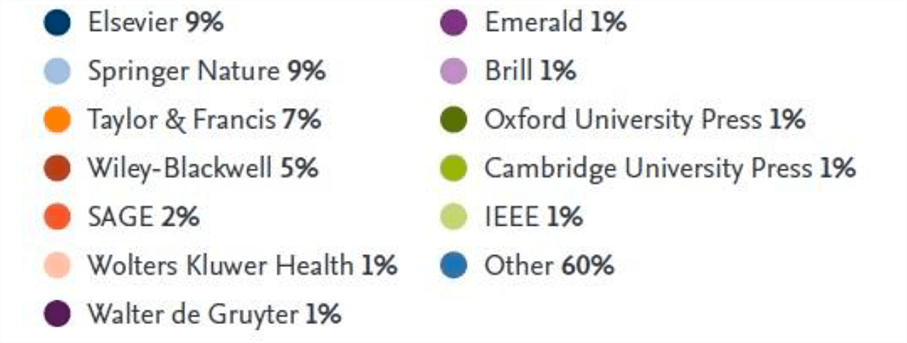
Figure 1: the leading publishers by percentage of content in SCOPUS in 2023 (see text)
https://www.elsevier.com/products/scopus/content
The landscape of academic publishing is far larger than many realise. It is akin to an iceberg, where the largest and longest established academic publishers (Figure 1) are underpinned by a very large number of smaller publishers, some of which are expanding rapidly through effective online business and promotional models.
Elsevier records more than 7000 publishers of SCOPUS listed Journals. These are all recorded on the regularly updated SCOPUS but unstructured Source title list on a huge spreadsheet of 47,000 journals, wherein 12 major publishers account for 40% or the titles (Figure 1). Many other publishers only publish one or two journals.
Even these figures do not address the full extent of the academic publishing ecosystem. The SCOPUS data only reflects those publishers whose content has been judged to be of a sufficient standard to be listed in the SCOPUS collections. Many other publishers submit content which is not deemed suitable for publication, and these publishers go unrecorded.
The task is of evaluating publishers is difficult. It is not a matter of choosing between black and white. There is a continuum of quality from the very good to the very poor, and publishers evolve, change, adapt, merge and dissolve. Moreover, the internet is a great leveller, in which attractive screen and website design can conceal the true nature of the operation behind the interface, and because established publishers sometimes lag behind start ups in terms of “web appeal”. “Predatory” publishers are highly adaptable and very capable of mimicry.
The Classification of Academic Publishers
We may classify publishers in a range of different ways, including:
- by the format of their research outputs, whether as books or journals;
- by their delivery vehicles for content, whether in print, online or hybrid formats
- by their subject coverage policies. Within the research publication category, some publishers have broad portfolios of subject coverage, while others may focus on STEMM (Science, Technology, Engineering,
Medicine and Mathematics) subjects, or on Arts, Humanities and Social Sciences subjects. Others may specialise in single topics.
- by the institutional foundations of the publishing organisation, which may include commercial publishers, universities and university presses, and scholarly Associations.
- by their business and operational model and the sustainability of their income and profits;
- and by their perceived integrity and trustworthiness in the marketplace.
“Open Access” Publishing
Whatever their business model, many publishers now describe themselves and their business model as Open Access Publishing. The Open Access movement was originally intended to open up the academic publishing market, so as to make content much more freely available and independent of the control of the major publishers. It was intended to give the widest and earliest possible exposure of an article on publication, free of controlled and restricted access behind publisher paywalls.
Open Access certainly gave authors greater freedom of choice of publisher, in exchange for a direct payment by the authors, or by their sponsoring institution, to meet the costs of publication by a new breed of publishers. However, the major publishers have also effectively adapted their business models towards open access publication.
The Open Access movement has had a profound and under-appreciated impact on academic publishing. For the first time, it made the direct linkage between a payment and the publication of an article respectable. This was previously regarded as a form of “vanity publishing”. To make the model work, there was an expectation that publishers would continue to uphold the trusted standards of peer review and rigorous article selection, and that a publication fee would only be levied on articles which had passed this rigorous selection process.
Regrettably, the original “ideals” of the Open Access movement of the past decade became subverted by a flood of new journals from a global surge of new publishers of unknown provenance and untested integrity. Human nature being what it is, it became easier and easier to secure publication of an article, regardless of its (lack of) quality, by payment to a publisher whose quality assurance standards and practices were weak, non-existent or fictitious.
The major publishers have created series of Open Access and online journals to partner their flagship subscription journals. Access of the viewing public to content is now generally either dependent upon variants of the authors-pays model, or pay-per-view access. This very complex marketplace challenges intending authors to make difficult choices as to where to send their articles for publication, and how to fund the publication.
Of course, the very best articles will readily secure publication in the world’s flagship journals, such as Nature, Cell and Science. However, for the huge number of middle ranking articles and their authors, a mistake in journal selection can be costly, both financially and in terms of personal reputation.
The challenges of choosing a vehicle for publication of an article are further compounded a range of Open Access models, as for example Green and Gold Open Access. The Creative Commons movement has also evolved a range of copyright models which include monetised options. Subscription-based, Professional Society, Association and Institutionally funded journals continue to function, but they have been increasingly challenged by the “Author pays” or “pay to publish” models in various “open access” wrappers.
Publishing Ethics, Quality Assurance and “Predatory” Behaviour among Publishers
Fraudulent behaviour is widely recognised at the author, article and journal level in academic publishing. The best run and most responsible publishing houses can be challenged to detect, address and publicise it in all instances, and the academic literature is undoubtedly suffused with fake and fraudulent content to an immeasurable degree.
However, the academic publishing industry almost certainly includes an unquantified number of bad actors at the publisher level. Such publishers will either turn a blind eye to fraudulent author behaviour or merely pay lip service to quality assurance systems such as rigorous peer review or plagiarism detection systems in their pursuit of the author’s money. In crude terms, it is now possible to get anything published somewhere, by journals and by publishers whose sole focus is income rather than quality.
Jeffery Beall of the University of Colorado provided global leadership in articulating concerns about what he designated as predatory publishers (and predatory journals) through his Scholarly Open Access blog, until growing institutional and legal pressures silenced his public commentaries in 2017 (1). An educational resource on predatory publishing is maintained by librarians at the Himmelfarb Health Sciences Library of George Washington University, in Washington DC (2).
Beall’s work on predatory journals was superceded by the Cabells’ Scholarly Analytics Company of Beaumont, Texas. Cabells maintains a “Whitelist” of internally validated journals using a combination of metrics data and more than 70 qualitative and quantitative criteria which are curated by a Board of Advisers.
Cabells also maintains a “Blacklist” of journals which are non-compliant to a greater or lesser degree around graded criteria which include Integrity, Peer Review, Publication Practices, Indexing, Metrics, Fees, Access and Copyright, Business Practices, and Website factors. These findings are published in the “Journalytics Medicine with integrated Predatory Reports” product, but Cabells does not offer such gradings at the Publisher level.
Nevertheless, the term “predatory” has persisted to encompass a range of widely perceived sharp practices in academic publication. A culture of unethical or criminal behaviour in pursuit of profit may affect an entire portfolio of journals, some or all of which may have been created solely for predatory purposes.
The observed lessons of Jeffery Beall’s experiences were very important. He unintentionally demonstrated how difficult it is to quantify and classify subjective observations and suspicions about the integrity of a publisher in a form that will stand up to rigorous cross examination. Moreover, newcomer publishers with novel internet publishing models who originally gave rise to “predatory” concerns have proved adaptable, evolutionary and resilient in the academic marketplace.
The Exposure and Sanctioning of Fraudulent Publishers
Further problems lie in the lack of agreement and interest across national jurisdictions as to the merit and importance of dealing with publishing malpractice at the publisher level. There is also considerable obfuscation as to the ownership of many publishers and as to the geographic jurisdictions in which they fall.
Vit Macháček and Martin Srholec noted in 2022 (3) that “Predatory” (or fraudulent) scholarly journals exploit the paid open-access publication model: The publisher receives money directly from the author... this creates a conflict of interests. Authors are motivated to pay to have their work published for the sake of career progression. In return, predatory publishers turn a blind eye to any limitations of paper... the worst of them fake the peer-review process and print almost anything for money”. They concluded that:
“The open-access model is a defining element of predatory journals, but it is not at fault per se. The inherent conflict of interest does not have to be exploited. There are effective means to ensure the quality of the editorial practices of journals... including open peer review”.
It is implicit that systematic and unaddressed fraudulent behaviour in individual journals reflects the culture and behaviour of their publishers, such publishers are not generally censured in the same way that individual fraudulent articles may be redacted and individual journals may be delisted from SCOPUS or Web of Science systems.
The OMICS Exemplar
One noteworthy exception to the general direct lack of censure of fraudulent publishers was the action of the US Federal Trade Commission against the company OMICS in 2019. Owen Dyer (4) reported in the BMJ that: “OMICS is a publisher of “predatory” academic journals that earn revenue by charging fees to authors. It must pay $50.1m (£38m; €45m) to the US government after a federal court in Nevada found that its “unfair and deceptive practices” had breached the Federal Trade Commission Act. The company deceived thousands of authors and scientists who attended conferences organised by its de facto subsidiaries, the court found. It also misled authors about peer review, publishing fees, journal impact factors, and indexing of journals in public libraries”.
It remains to be seen whether this ruling will have a wider impact on the industry.
Observations of Publisher Integrity from SCOPUS Title Evaluation Programmes
Over the past 15 years, I have been privileged to review and provide feedback on some 4000 journals which have been submitted to SCOPUS for consideration of a listing. Such listings are much sought after for their academic recognition and are for the commercial value that follows for many of the successful applicants. In many countries, publication and authorship in a SCOPUS or a Web of Science listed journal is a key factor in suitability for academic promotion. This has created substantial demand and scope for profit, and a shadow industry of advisors on how to secure publication in a SCOPUS or Web of Science listed journal.
Applicant journals to SCOPUS are validated through the SCOPUS Title Evaluation Platform (STEP) against a range of published quality assessment criteria. These do not include an explicit appraisal of the publisher. This evaluation process nevertheless necessarily exposes regular journal reviewers to a wide range of publisher types. For the 50% or so of journals which do not reach a threshold of acceptance for a listing, publisher-related factors can contribute to concerns. These concerns are not formally captured or recorded, but various forms of public internet-based open source Intelligence (OSINT) allow further informative investigation.
Useful OSINT Assets include:
- Google Earth, Maps and StreetView, for the checking of corporate addresses and residences
- Google and Google Scholar for the checking of titles, publisher website and public experiences of dealing with particular publishers and Journals
- The SCIMAGO website, for the titles comparative studies of journals in given subject fields and in specified countries and regions;
I have therefore sought to characterise the indirect factors which provide greater insight into the ethics or business model of an academic publisher, rather than of a particular journal. Patterns often become apparent when evaluating multiple journals from any one publisher.
Multiple sources of evidence must be explored and taken into account. For example, no publisher or journal will now omit reference to a code of ethics, to vigorous policies to counter malpractice, or robust peer review and archiving policies, even if there is no substance in their practice to such claims.
A classification of Academic Publishers by Business Model
It should always be possible to identify and infer the publishing model and the publisher of a journal or other academic text, either from the publication itself or from the publisher’s website, and hence to identify the country of origin and the jurisdiction of the business.
A. The “Major” Commercial Publishers:
The major established academic publishers are characterised by the following features:
- A clear and well documented public history that usually predates the open access era and that can be validated from a wide range of sources;
- Foundation and a demonstrable corporate centre of gravity in a trusted national jurisdiction with full legal powers and public accountability;
- Public listing and ownership with transparent shareholders and a traceable investment record;
- An identifiable headquarters, corporate structure, and open lines of managerial accountability, and an invested infrastructure for academic publication with responsible officers;
- A portfolio of journals and/or academic publications which are accountable to, and trusted by the mainstream academic community;
- Clear and transparent funding, archiving, ethics and malpractice management policies.
B. “New entrant” “online only” publishers (2009 onwards)
A large number of new publishers have emerged to take advantage of the transformed economics and the simplified practicalities of global internet publishing, and consequently of the Open Access era. All such publishers have a similar low cost base. There is a spectrum of large online only publishers which emerged around this business model. Examples include:
- Frontiers Media SA, whose journals are characterised by “Frontiers in (Subject)” titles
- MDPI (Multidisciplinary Digital Publishing Institute), whose journals are often characterised by single word titles, such as “Acoustics”, Actuators” and so on
- Hindawi, which was originally an Egyptian publisher, whose portfolio expanded from 1997 onwards to 250 journals, before it was taken over by John Wiley and Sons. The brand was subsequently dropped over malpractice concerns around paper mills, which generate and publish fake papers and/or sell authorship.
C. Mono-Institutional Publishers
This category includes a number of long established high performing publishers, such as Oxford University Press and Cambridge University Press, with large and respected portfolios of journals and textbooks.
There is a much larger population of journals which are published by individual Universities and by individual University Departments or Hospitals. These publishers and their journals provide an entry level outlet for the publication of locally generated content. Their journals are often multidisciplinary in content, thus defying a unifying subject classification.
A further challenge for institutional publishers is that they often functionin countries where every institution publishes its own journals in the same subject areas. This dilutes the quality and impact which follows from the greater academic mass and specialisation which is achievable with regional or national level journals through inter-institutional teamworking and collaboration.
Mono-institutional publishers have a range of business models of various levels of financial sustainability, from the fully professional and profit-driven ethical business to local institutional or departmental funding of their journals, with free access for authors.
Mono-institutional university and society publishers give control over content to the institution, and they provide a vehicle for publication by their local and affiliated authors. However, globally, they generally suffer from similar constraints of a narrow authorship, a narrow readership base and a narrow editorial base. Such publishers thus struggle to secure sufficient quality and specialisation of content to become competitive with their national, regional and international competitors.
Nevertheless, institutional and society publishers usually offer a stamp of quality and trustworthiness, because the institutional reputation is tied to the quality of its journal portfolio.
D. Societies and Professional Associations as Publishers
Most academic societies and associations now partner with established publishers, either on subscription based models through their membership, or in various forms of profit sharing agreement with the publisher.
However, some of the larger US societies act as their own publishers. For example, the American College of Chest Physicians publishes a portfolio of journals under the CHEST brand, and the American College of Physicians similarly publishes under the ACP brand.
The Institute of Electrical and Electronics Engineers (IEEE) is a major publisher of journals and conference proceedings, and of textbooks and reference works in partnership with John Wiley and Sons.
The Association of Learned and Professional Society Publishers (ALPSP) is an international trade association which supports and represents not-for-profit organizations that publish scholarly and professional content, and those that work with them. It claims 350 mmber organisations across 35 countries.
E. Government and State Departmental Publishers
A number of respected public bodies publish reports, data sets and public sector statistics, for example in areas of public health, population and disease censuses, which are listed in citation systems. For example, the US Centre for Disease Control produces a series of Mortality and Morbidity Weekly Reports, Summaries and Supplements for health professionals under the MMWR brand.
F. Trade Publishers
Trade journals provide advertorial publication for a particular business, corporate or professional audience. They carry news, advertising and a number of informative articles which may or may not be written in an academic format. Such a journal can be challenging to define. They are often published by general commercial and magazine publishers with no specific expertise or interest in the academic marketplace.
G. Patents Publications
Patents are publications which also confer ownership rights on an idea. They are usually processed and published by National or Regional Governmental Patent Offices, such as the United States Patent and Trademark Office.
H. Publishers of Conference Proceedings
Conference proceedings are a collection of academic papers which published in the context of a particular academic conference or workshop. They are often published by specialist conference publishers, including IEEE. Other Proceedings may be published as books or book series by generalist publishers such as Springer, with its Lecture Notes in Computer Science book series which has been running since the 1970s. Some conference publishers also act as organisers or conferences.
The term Proceedings (aka Transactions, or Acta) is also used in the title of some well established academic journals, as for example the Proceedings of the National Academy of Sciences (of the USA). Proceedings are edited and published to similar standards and academic journals, but for the observation that content is determined specifically by the contributors the conference and to particular themes. Conferences are notably vulnerable to predatory and “fake” organisations and publishers.
I. The Editor as publisher
Self publishing is another form of journal publication, where the editor is both the owner and the publisher. Such journals are likely to have very poor governance or sustainability, as they may be intended primarily as personal vehicles for the views of the editor.
J. Preprint Servers as Publishers
Preprints servers are on line publishing systems that post articles which have not (yet) been peer reviewed or accepted by journals. They offer the advantages of wide distribution, speed to publication, absent publication charges, and freedom from peer review until they proceed to journal publication. They also expose content to commentaries, to employers and to funding bodies. However, not all content which is listed in Preprint Servers proceeds to publication elsewhere, and there is no obligation on authors to do so.
Preprint servers are owned and published by a variety of organisations, including academic institutions, commercial publishers and Charitable Foundations. For example,
- Arxiv was the first major preprint server, and it is supported by Cornell University
- BioRxiv is supported jointly by the Cold Spring Harbour Laboratory and the Chan-Zuckerberg Foundation (Facebook)
- The University of Oxford promotes the Open Access Oxford preprint server
- MedRxiv is co-published by the Cold Spring Harbour Laboratory, the BMJ Publishing Group and Yale University.
The ASAPbio (Accelerating Science and Publication in biology) organisation maintains a list of current Arxiv systems at https://asapbio.org/.
The major preprint servers may now be regarded as publishers in their own right for papers
which are not subsequently published in “mainstream” journals. However, there is considerable debate as to whether articles and journals which do not use peer review can be listed for citation purposes in the absence of such quality control. For example, the Web of Science recently delisted the journal eLife over such concerns (5.)
K. EPrint Servers
Many institutions now use locally controlled ePrint servers for the compilation and internet
accessibility of locally produced content. Given the rising cost of open access publication, we
may anticipate that ePrint servers will progressively become formal publishing vehicles. Some governments have also developed national academic repositories for content as for example the HRCAK repository in Croatia.
Discussion
A simple classification of publishers is likely to be of considerable international public benefit. This is not an exact science, and publishers evolve their business practices, their portfolios and their geographical locations over time. Individual authors, content users, evaluators and legislators must make choices based on informed research in the process of building a “Confidence Index” of publishers. This will allows us to identify good and bad practices and to discriminate between ethical, high quality academic content and lesser quality and predatory content. The evaluation factors include:
- The provision of General Information and Transparency about the publisher and its history:
- The geographic centre of gravity of the publishing operation and the national jurisdiction to which it is answerable:
- The Financial Model and the sources of financial transparency of the business
- The scope of the publisher’s academic portfolio.
Much information about bona fide publishers is readily discoverable on the Internet. Such information can be supplemented by a search of the web sites and membership lists of aggregator agencies such as the Open Access Scholarly Publishers Association (OASPA), the Directory of Open Access Journals (DOAJ) and the membership list of the Committee on Publication Ethics (COPE).
Many established publishers now offer “hosting services” to small and under-resourced regional, national, institutional or a society journals and help to nurture and develop them with corporate culture, branding, expertise and resources, in return for a financial agreement on profit sharing.
Bona Fide academic publishers will seek to secure standards in all aspects of the publishing practices of its journals and book editors. Support mechanisms will include:
- Oversight of the appointment of editors and editorial board members, and support for their career development.
- Provision of a manuscript management system, such as The Elsevier Editorial Manager, or the ScholarOne Journal Workflow Management System (Clarivate Analytics)
- Support for the indexing of their publications in quality assured abstract and citation databases such as SCOPUS and Web of Science, and their journals will have validated citation metrics.
- The provision of long term document archiving and retrieval systems, whether through internal corporate systems or third party archiving systems such as JSTOR, CLOCKSS and LOCKSS.
- Provision for Copyright arrangements and Creative Commons rights.
- Clarity from the outset in all matters relating to publication fees.
In Conclusion
The behaviours of authors, institutions, journals, and publishers are closely interlinked in the generation or undermining of trust in the global academic ecosystem. Modern bibliometric systems pay close attention to the performance indicators of authors, institutions, journals. However, as yet there is no accepted and systematic measurement and classification of publishers and their performance.
The formal development of a classification system for academic publishers is overdue. A practical system will help to increase trust, transparency, understanding and oversight of the entire academic publishing process.
Acknowledgements
I am grateful to many colleagues for discussions and insights in this subject area during my privileged consultancy work for the Content Selection and Advisory Board to the SCOPUS Citation and Bibliometric system over two decades.
The ideas and issues raised in this essay are my own, and should not in any way be construed as representing the corporate views, policies or intent of Elsevier BV, as the owners of SCOPUS.
References
1. Beall, J. (2017). What I learned from predatory publishers. Biochemia Medica, 27(2), 273-9. doi: 10.11613/BM.2017.029
2. Educational Resource on predatory publishing. The Himmelfarb Health Sciences Library of George Washington University, in Washington DC Accessed 2nd March 2025
https://guides.himmelfarb.gwu.edu/PredatoryPublishing/Beall
3. Macháček, V., & Srholec, M. (2022). Predatory publishing in Scopus: Evidence on cross-country differences. Quantitative Science Studies, 3(3), 859–887. doi.org/10.1162/qss_a_00213
4. Dyer O. US consumer agency wins $50m order against predatory publisher OMICS BMJ 2019; 365 :l1639 doi:10.1136/bmj.l1639
5. Kincaid E. eLife is the latest in string of major journals put on hold from Web of Science. Retraction watch blog, 24.10.2024.
https://retractionwatch.com/2024/10/24/elife-latest-in-string-of-major-journals-put-on-hold-from-web-of-science/
